Notes · money & taxes
The home office deduction, for freelancers
The regular and exclusive use test, the $5 per square foot shortcut versus actual expenses, a worked example, and what to keep.
Updated 2026-11-26
If you freelance from home, part of your home may count as a business expense. The IRS calls it the deduction for business use of your home, and most people know it as the home office deduction. It lowers your business profit, which is the number both your income tax and your self-employment tax are figured from.
It also has a reputation for being complicated. Most of it comes down to one test about how you use the space and one choice between two ways of doing the math. This note covers both, with a worked example. It's general information for US freelancers, not tax advice; a tax professional can check your situation.
The test: regular and exclusive use
To qualify, a part of your home has to be used regularly and exclusively for your business, and it has to be your principal place of business (IRS Publication 587). Taking those one at a time:
- Exclusive means the space is only used for work. Publication 587 says it can be "a room or other separately identifiable space," and it "does not need to be marked off by a permanent partition." So a desk area in the corner of a bedroom can count, as long as that corner isn't also used for other things.
- Mixed use fails. The publication's own example: a den used for work and also for family recreation is not used exclusively for business, so no deduction for the den. A kitchen table you work at during the day won't pass either.
- Principal place of business includes doing your administrative or management work there (billing, scheduling, bookkeeping) when you have no other fixed location where you do substantial administrative or management work. A freelancer who sees clients at their offices but does all the invoicing and planning at home can still qualify.
There are two exceptions to the exclusive-use rule in Publication 587: storing inventory or product samples, and running a daycare. Most freelancers won't use either.
One more point that trips people up: this is for self-employed people. The IRS says employees can no longer claim a home office deduction, even with the simplified method (IRS, Simplified option for home office deduction). If you have a day job and freelance on the side, the deduction can only apply to the freelance business, and only for space used for it.
Checked November 26, 2026. General information, not tax advice.
Method one: the simplified option
The IRS's simplified option is a flat rate: $5 per square foot of the space used for business, up to 300 square feet (IRS, Simplified option). That makes the largest possible deduction 300 × $5 = $1,500 a year.
What comes with it, according to the same page and Publication 587:
- No receipts for rent or utilities needed for the deduction itself. You need the square footage and proof the space qualifies.
- You can't deduct depreciation on the home for those years, which also means there's nothing to recapture for them if you sell.
- If you own your home and itemize, your mortgage interest and real estate taxes are claimed in full on Schedule A, not split with the business.
- The deduction can't be more than the gross income from the business use of your home minus your other business expenses, and with this method any excess can't be carried over to next year.
Method two: actual expenses
The regular method works out the share of your home used for business and applies that share to the real costs of running it. Publication 587 lists the kinds of expenses involved: rent if you rent ("you can deduct part of the rent you pay"), or mortgage interest, real estate taxes and depreciation if you own, plus utilities, insurance and repairs. Self-employed people using this method fill in Form 8829, which Publication 587 walks through.
The usual way to find the business share is area: the office's square footage divided by the whole home's. It takes more record keeping, but if your space is large or your housing costs are high, the number can be well above $1,500. If the deduction is limited by your business income in a year, the regular method lets you carry the rest forward to the next year you use actual expenses; the simplified method doesn't.
Checked November 26, 2026. General information, not tax advice.
A worked example
Say you rent a 1,000 square foot apartment and use a 100 square foot spare room only for work. Your rent is $1,600 a month and utilities and renter's insurance come to $200 a month. Your net freelance profit before this deduction is $40,000.
- Simplified: 100 sq ft × $5 = $500.
- Actual expenses: the room is 10% of the apartment. Rent, utilities and insurance are $1,800 a month, or $21,600 a year. 10% of that is $2,160.
Both are well under the $40,000 profit, so the income limit doesn't come into it here. In this example the actual-expense method gives the bigger deduction, at the cost of keeping a year of rent and utility records. With a small room in a cheaper home, the gap can close or flip. The IRS says you choose by using a method on your timely filed, original return for that year, and Publication 587 notes you can switch methods from year to year.
To see what a deduction like this is worth in tax, the freelance tax calculator takes your profit and gives a rough income and self-employment tax figure. Run it twice, with and without the deduction.
Records worth keeping
- A measurement and a photo. The size of the space and of the whole home, plus a photo of the setup, taken this year. It shows the space existed and was set up for work.
- Housing bills, if you use actual expenses. Rent or mortgage statements, utilities, renter's or homeowner's insurance, repair receipts.
- Your business income. The deduction is capped by what the business earned, so you need a clean record of what came in. Freelance record keeping covers what to keep and for how long.
- Proof you worked there. Time logs and invoices made in that space help show regular use.
A separate business account makes the income side much easier to show, and if you're still sorting out what to set aside through the year, quarterly estimated taxes explains the January 15 payment.
Where tab helps
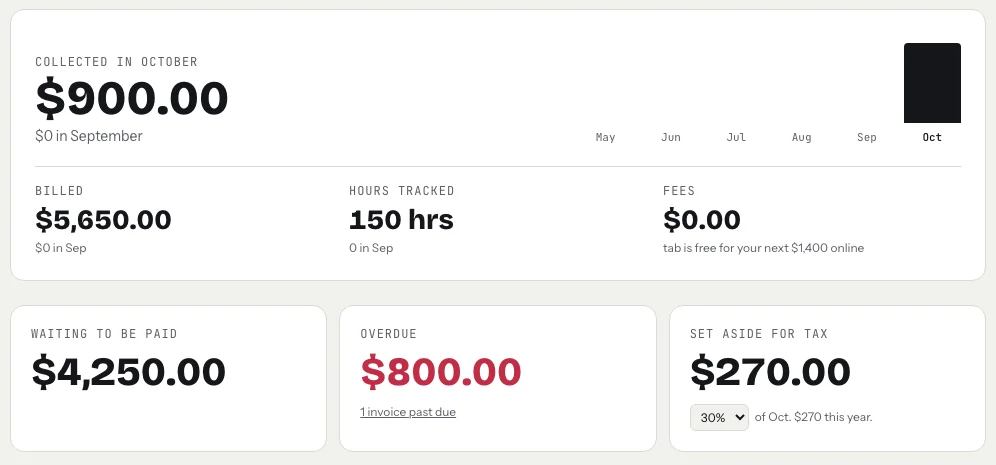
tab doesn't track expenses or figure deductions; your rent, bills and measurements live outside it. What it keeps is the income side: every hour you worked, every invoice and every payment. The Money screen shows what you collected each month, and the export gives your time entries, invoices, payments and clients as CSV files for you or your accountant, free on every plan.

If you'd rather start with one invoice, the free invoice generator makes a PDF without an account, and the meter on the homepage starts counting today's hours right now.
Try it on this page
A real clock, right here. No account.
Press start, or type the time you already worked. Keep it in tab when you like it.
Keep reading
 Quarterly estimated taxesWho pays, the four 2026 dates, an easy amount to aim for, and how to pay before January 15.
 Freelance cash flowPayment terms, deposits, prompt invoices, a buffer and a tax account: six habits that keep you afloat.
 Freelance record keepingWhat to keep (invoices, payments, time, receipts), how long the IRS says, and a simple system.
Questions
Can freelancers take the home office deduction?
Yes, if part of the home is used regularly and exclusively for the business and it's the principal place of business, which includes doing your administrative work there when you have no other fixed place for it. Employees can no longer claim it.
How much is the simplified home office deduction?
$5 per square foot of the space used for business, up to 300 square feet, so at most $1,500 a year. The deduction can't be more than the business income from using the home, minus other business expenses.
Does a corner of a room count as a home office?
It can. IRS Publication 587 says the business area can be a room or other separately identifiable space and doesn't need a permanent partition, but it must be used only for business. A space also used for family or personal things doesn't qualify.
Can renters take the home office deduction?
Yes. With the actual-expense method, renters who meet the requirements can deduct the business share of their rent, usually figured by the office's square footage as a share of the whole home.
Keep the income side tidy.
tab tracks every billable hour, turns it into invoices, shows what you collected each month and exports it all as CSV. Free to start, no account to try it.
Start free Sign up with emailFree to startNo cardNo screenshots, ever