Notes · money & taxes
Quarterly estimated taxes: a plain guide for freelancers
Who has to pay, the four dates, an easy way to choose the amount, and how to pay before January 15.
Updated 2026-11-18
When you had a job, tax came out of every paycheck before you saw it. Client payments arrive whole. Nobody holds anything back, so the IRS expects you to send it yourself, a few times a year, as you earn. These are estimated tax payments, and the last one for 2026 is due on January 15, 2027.
This note covers who has to pay, the four dates, how to work out an amount without doing a full tax return in your head, and how to pay. It's general information for US freelancers, not tax advice. Your state may want its own estimated payments too, and a tax professional can check your numbers.
Who has to pay estimated tax
The 2026 Form 1040-ES gives the general rule. You must pay estimated tax for 2026 if both of these apply (IRS, 2026 Form 1040-ES):
- You expect to owe at least $1,000 in tax for 2026, after subtracting withholding and refundable credits.
- You expect your withholding and refundable credits to be less than the smaller of 90% of your 2026 tax, or 100% of the tax shown on your 2025 return (your 2025 return must cover all 12 months).
The form also has an exception: you don't have to pay estimated tax for 2026 if you were a U.S. citizen or resident alien for all of 2025 and had no tax liability for the full 12 months of 2025, meaning your total tax was zero or you didn't have to file. Zero means the total tax line on your 2025 return, not the balance due when you filed. If you had a job last year, got a refund and still had some tax on your return, you had a tax liability, and the "last year's tax" target below is the one to use. If the exception does apply to you, you still owe your 2026 tax; it's due with your return in April.
The four dates
For the 2026 tax year, the form lists these due dates, and IRS Publication 505 gives the months each one covers:
- April 15, 2026, for income from January through March.
- June 15, 2026, for April and May.
- September 15, 2026, for June through August.
- January 15, 2027, for September through December.
The periods aren't equal quarters, which catches people out. And there's a footnote on the last one: you don't have to make the January 15, 2027 payment if you file your 2026 return by February 1, 2027 and pay the entire balance with it. If a due date falls on a weekend or holiday, a payment the next business day counts as on time (IRS, Estimated taxes).
Checked November 17, 2026. General information, not tax advice.
What you're paying: income tax plus self-employment tax
Freelance profit carries two taxes. There's regular income tax, and there's self-employment tax, which is Social Security and Medicare for people who don't have an employer paying half. The IRS puts it at 15.3%: 12.4% for Social Security and 2.9% for Medicare (IRS, Self-employment tax). For 2026, the Social Security part applies to the first $184,500 of your combined wages and self-employment earnings.
Two details from the 1040-ES worksheet soften it. The tax is figured on 92.35% of your net profit, not all of it, and half of the self-employment tax is deducted when you figure your income (2026 Form 1040-ES, self-employment tax worksheet).
A worked example with the worksheet's own steps. Say your net profit for the year (what clients paid, minus business expenses) is $40,000:
- $40,000 × 92.35% = $36,940
- $36,940 × 15.3% = $5,651.82 of self-employment tax
- Half of that, $2,825.91, comes off your income before income tax is figured.
Income tax comes on top, and it depends on your filing status, deductions and other income. The freelance tax calculator gives a rough figure for both in one go.
Checked November 17, 2026. General information, not tax advice.
The simplest way to pick an amount
You don't have to predict this year perfectly. The rule above has two targets, and you only need to hit the smaller one to avoid the underpayment penalty:
- Last year's tax. Pay 100% of the total tax on your 2025 return, split across the four dates. If your 2025 tax was $6,000, that's $1,500 a payment. It's the easiest target because the number already exists. One exception from the form: if your 2025 adjusted gross income was more than $150,000 ($75,000 if married filing separately), the target is 110% instead.
- This year's tax. Pay 90% of what you expect to owe for 2026. Better if this year is clearly smaller than last.
Either way, you still owe whatever is left when you file. The targets only decide whether a penalty applies, and the penalty is charged for each payment by the number of days it remained unpaid (2026 Form 1040-ES, When a penalty is applied).
If your income is lumpy, say a quiet spring and a busy autumn, equal payments can overpay early. The annualized income installment method lets you match payments to when you earned the money; it's explained in chapter 2 of IRS Publication 505 and needs Form 2210 with your return.
How to pay
The IRS lists several ways (IRS, Payments):
- IRS Direct Pay straight from a checking or savings account, free, no sign-in needed. Choose estimated tax and the right year.
- Your IRS online account, also free from a bank account, and it shows the payments you've already made.
- EFTPS, free, but you have to enroll first.
- Debit or credit card, through a payment processor that charges a fee.
- Check or money order with a 1040-ES voucher, mailed to the address for your state listed on the form.
Keep the confirmation for each payment. You'll enter the total paid on your return in April, and your own record is the quickest way to get it right.
Checked November 17, 2026. General information, not tax advice. Rules can change; check irs.gov or ask a tax professional for your situation.
If you've missed earlier dates this year
It happens to a lot of first-year freelancers. Paying now still helps: the penalty works like interest on each late or short payment, so the sooner a shortfall is covered, the smaller it gets. Work out what you should have paid by now, pay it, and make the January 15 payment on time. If you can't pay the full amount when you file, the IRS offers payment plans you can apply for online; the 1040-ES notes a user fee is charged.
Make it a habit, not a scramble
Estimated tax is easy to pay and hard to save for at the last minute. A few habits help:
- Move a share of every client payment into a separate account the day it arrives. A separate business account explains the setup.
- Put the four dates in your calendar with a reminder a week before each.
- Check your numbers each quarter. The quarterly look back is a good moment to see whether this year is running ahead of last.
- Know what you actually collected, not what you invoiced. Fees come off card payments before the money lands; the payment fee calculator shows how much.
Where tab helps
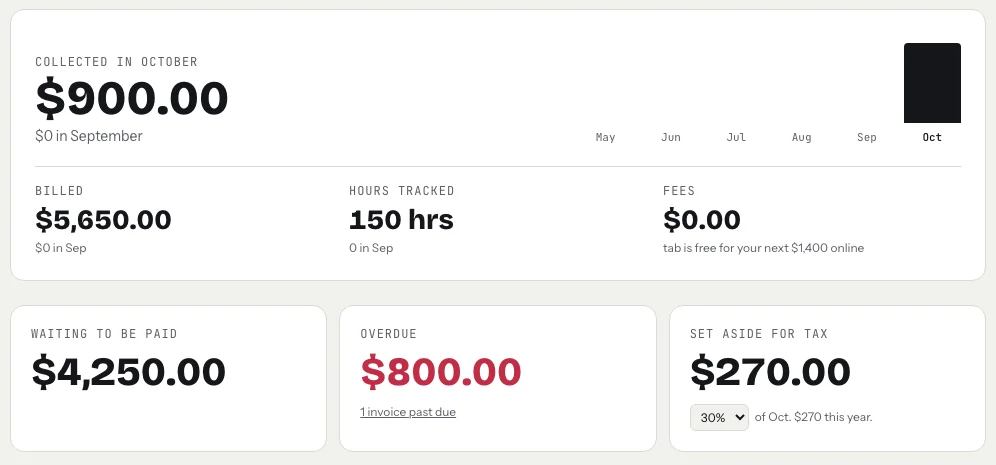
tab doesn't calculate or pay your taxes. What it does is keep the numbers you need for them. The Money screen shows what you collected each month and a set-aside amount for tax, at a percentage you choose, with a running total for the year. You can export your invoices and payments as CSV whenever you or your accountant need them.
And since the tax follows the income, the first step is billing all the hours you work. You can try the meter on the homepage without an account.
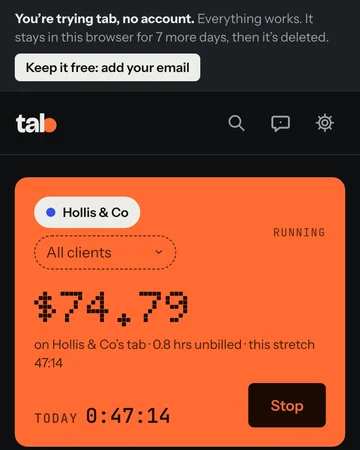
Try it on this page
A real clock, right here. No account.
Press start, or type the time you already worked. Keep it in tab when you like it.
Keep reading
 Freelance cash flowPayment terms, deposits, prompt invoices, a buffer and a tax account: six habits that keep you afloat.
 Freelance record keepingWhat to keep (invoices, payments, time, receipts), how long the IRS says, and a simple system.
 The quarterly look backFive questions to answer before each estimated tax payment, and one thing to change.
Questions
When is the last 2026 estimated tax payment due?
January 15, 2027, according to the 2026 Form 1040-ES. You don't have to make that payment if you file your 2026 return by February 1, 2027 and pay the entire balance due with it.
Do I have to pay quarterly taxes as a freelancer?
Generally yes, if you expect to owe at least $1,000 in tax for the year after withholding and refundable credits. There's an exception if you had no tax liability for the full previous year.
How much should I pay each quarter?
A simple way to avoid the penalty is to pay 100% of last year's total tax, split across the four dates (110% if last year's adjusted gross income was over $150,000). Or pay 90% of what you expect to owe this year, whichever is smaller.
What is the self-employment tax rate for 2026?
15.3%: 12.4% for Social Security and 2.9% for Medicare, figured on 92.35% of your net profit. For 2026 the Social Security part applies to the first $184,500 of combined wages and self-employment earnings.
Know what to set aside, every month.
Track every billable hour, see what you collected and a tax set-aside by month, and export it all for your accountant. Free to start, no account to try it.
Start free Sign up with emailFree to startNo cardNo screenshots, ever