Notes · money & taxes
Freelance cash flow: how to stay afloat between payments
Six habits that bring client money in sooner and smoother, plus how to handle slow months and the tax bill.
Updated 2026-10-27
Freelance income rarely arrives the way bills do. Rent is due on the first, every month. Client money lands when a client gets around to paying, sometimes weeks after the work is done. You can have a great month on paper and still be short on the day the rent is due. That gap between earning money and having it is cash flow.
You can't control when every client pays, but you can control a lot of the timing. Here are six habits that keep money coming in steadily, plus how to handle the two things that catch new freelancers out: the slow month and the tax bill.
1. Set short, clear payment terms
Payment terms are how long a client has to pay after you invoice. Agree them before the work starts and write them in your contract or quote. Shorter terms mean money sooner, and there is nothing wrong with asking for 14 days instead of 30. Whatever you agree, put a real due date on every invoice, not "due on receipt".
In tab, each client has a "Payment due in" setting (14 days unless you change it), and every invoice for that client gets a real due date from it.
2. Ask for a deposit on project work
For a fixed-price project, ask for part of the fee before you start. A deposit means you're never more than a few weeks of work out of pocket, and it shows the client is committed. Split the rest into parts tied to stages of the work, so you're paid as you go instead of all at the end.
tab supports this for fixed-fee projects: set the fee, split it into parts, and bill them one at a time. The first part can go out as soon as the client says yes.
3. Invoice promptly, and often
Every day between finishing work and sending the invoice is a day added to your wait. For hourly work, invoice on a fixed rhythm (weekly, every two weeks or at month end) instead of waiting until a project wraps. Smaller, regular invoices are easier for clients to approve and pay than one large one.
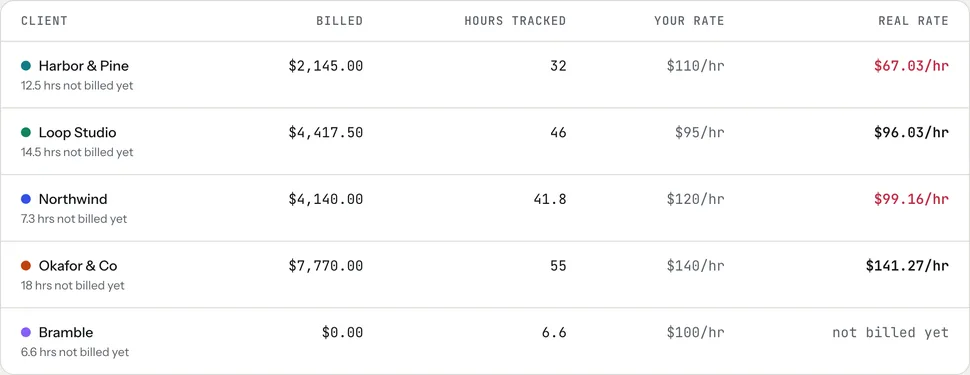
Unbilled hours are the easiest cash flow problem to fix, because you only have to send an invoice. tab shows what's on each client's tab, not billed yet, and turns those hours into an invoice in one step. Without an app, timesheet to invoice does the same from a list of hours.
4. Make paying take seconds
An invoice the client can pay with one click gets paid sooner than one that needs them to copy bank details into their banking app. Card and bank payments cost a fee, though, so know what you'll keep. On Stripe's standard US pricing, domestic cards cost 2.9% + 30¢ per successful payment (Stripe pricing) and ACH Direct Debit costs 0.8%, capped at $5.00 (Stripe: payment methods pricing). The payment fee calculator works out what lands in your account.
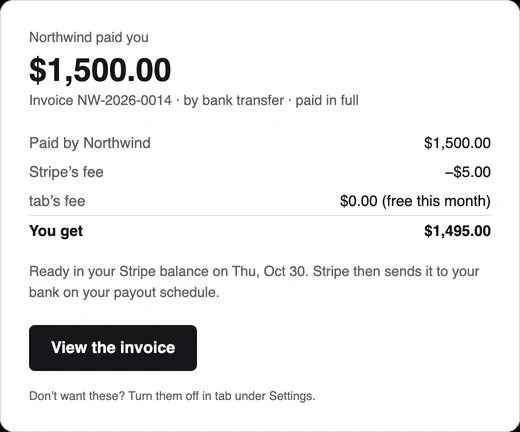
Clients pay tab invoices online by bank transfer or card, straight into your own Stripe account. There's no tab fee on the first $2,000 collected online each calendar month; Stripe's own fee is separate.
Checked October 26, 2026.
5. Follow up as soon as it's late
A late invoice usually needs a reminder, not a confrontation. Send a short, friendly note a few days after the due date, and a firmer one a week or so later. The unpaid invoice follow-up guide has a day 3, 10 and 21 schedule with the exact wording. In tab you can switch those reminders on per client and they go out automatically, from you.
6. Build a buffer
A buffer is money set aside to cover your basic costs when income is slow or late. It turns a late payment from a crisis into an inconvenience. Start with a goal you can reach, for example one month of essential costs, and grow it toward three. Put a fixed share of every payment into it until you get there, before you spend the rest.
Keep the buffer in a separate account so it doesn't blend into everyday spending, and only touch it for real gaps.
Don't spend the tax money
The quickest way to sink a good year is to spend money that belongs to the IRS. In the US, self-employment tax alone is 15.3% (12.4% for Social Security and 2.9% for Medicare), on top of income tax (IRS: Self-employment tax). Nobody withholds it for you, so if you expect to owe $1,000 or more, you generally have to pay estimated tax during the year (IRS: Estimated taxes), in four payments due April 15, June 15, September 15 and January 15 (IRS: estimated tax due dates).
The simple fix: every time a payment lands, move a percentage into a tax account. The freelance tax calculator gives you a federal estimate to start from (state and local tax are extra). This is general information, not tax advice; an accountant can set the right number for you.
Checked October 26, 2026.
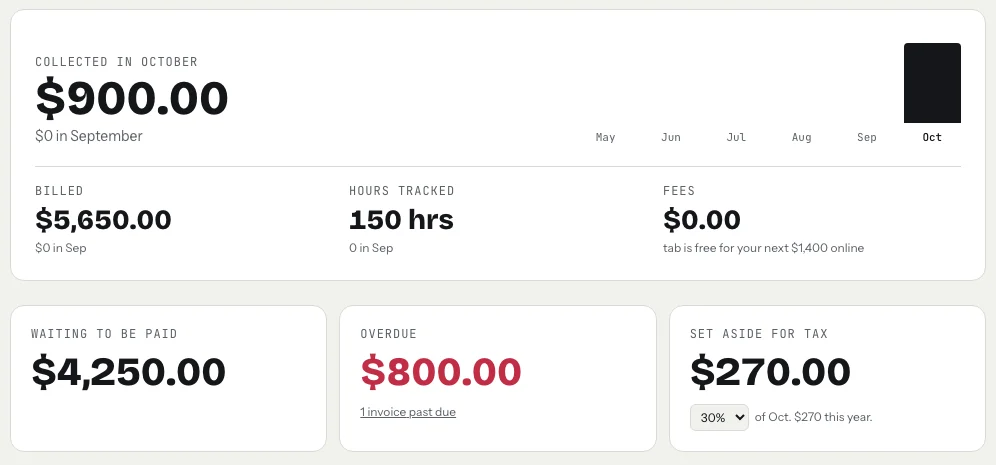
tab's Money screen puts the whole picture in one place: what you collected this month, what's waiting to be paid, what's overdue, and how much to set aside for tax at the percentage you choose.
Keeping it afloat
Cash flow is a bit like keeping a bubble in the air: small, steady pushes beat one big one. Short terms, a deposit, regular invoices, an easy way to pay, a prompt reminder, a buffer and a tax account. None of them is hard on its own, and together they keep money arriving before the bills do.
Keep reading
 Planning for a slow seasonYour monthly floor, a buffer from the good months, and the past clients to write to first.
 A separate business accountWhy the IRS says to keep business money apart, and how to set it up in an afternoon.
 An emergency fund, freelance styleYour monthly floor, a target in months, and a share of every payment until it's full.
Questions
How do freelancers manage irregular income?
Set short payment terms, take deposits on project work, invoice on a regular rhythm, follow up on late invoices quickly, and keep a buffer of essential costs in a separate account so slow months don't become emergencies.
What payment terms should a freelancer use?
Whatever you agree with the client in writing, with a real due date on every invoice. Shorter terms such as 14 days bring money in sooner than 30 or more.
Should I ask for a deposit as a freelancer?
For fixed-price project work, asking for part of the fee before you start is common and reasonable. Bill the rest in parts as stages are finished.
How much should a freelancer set aside for taxes?
It depends on your income, deductions and state. In the US, self-employment tax alone is 15.3%, before income tax. A freelance tax calculator gives a starting percentage; an accountant can confirm it.
Get paid sooner, without chasing.
tab turns your hours into an invoice the client pays online, reminds late payers for you, and shows what to set aside for tax. Free to start, no account to try it.
Start free Try it, no sign-upFree to startNo cardNo screenshots, ever