Notes · pricing
Good, better, best: three packages that fit together
Build the middle package first, price all three from your real rate, and check afterwards what each one actually paid.
Updated 2026-10-27
Send a client one price and you've asked a yes or no question. Send three, and the question becomes "which one?" That small shift is why so many freelancers offer good, better and best packages: three versions of the same service, nested like bowls, each one holding a little more than the last.
Packages also make pricing easier on you. Instead of building a custom quote from nothing every time, you decide once what each level includes and what it costs, then adjust for each client. Here is how to build three packages that make sense, how to price them from your real rate, and how to check afterwards that they paid what you meant them to.
Why three, and not one or five
One price gives the client nothing to compare except "do it" or "don't". Five or more gets confusing, and confused clients put off deciding. Three is easy to read in a few seconds:
- Good: the essentials, for a client with a tight budget or a small need.
- Better: what most clients actually need. This is the one you expect people to pick.
- Best: everything in Better, plus more of what clients value: speed, extra deliverables, more support.
The middle package is the center of gravity. Build it first, then make the other two by taking things away and adding things on.
Step 1: build the middle package
Start with the work you most often do for a typical client. Write it down as specific deliverables, not as a description of yourself. For a logo project, that might be:
- Three initial concepts.
- Two rounds of revisions on the chosen concept.
- Final files in the formats the client needs.
- A one-page guide to using the logo.
Then estimate the hours honestly, including the parts nobody sees: the kickoff call, research, emails, preparing the files. How to estimate project time has a method for this, including padding for the unknowns.
Step 2: price it from your rate
The simplest honest price is your estimated hours times your hourly rate, rounded up. If you don't have a rate yet, the hourly rate calculator works one out from the income you want and the hours you can bill, and the rate guides show typical ranges by profession.
Here is the arithmetic with example numbers. Say the middle logo package takes about 16 hours and your rate is $110 an hour: 16 × $110 = $1,760, which you might round to $1,800.
Then the other two
- Good: remove things, don't just discount. One concept instead of three, one revision round, final files only. Maybe 9 hours: 9 × $110 = $990, rounded to $1,000.
- Best: add things clients pay more for. A faster turnaround, a small set of extra items like social media icons, a third revision round, a follow-up call a month later. Maybe 26 hours: 26 × $110 = $2,860, rounded to $2,900.
These numbers are only an illustration; use your own hours and rate. The principle is what matters: each package's price comes from the work in it, so even the cheapest one pays your rate.
Step 3: make the differences easy to see
Clients compare packages line by line. Help them:
- Use the same list for all three, with each item included, not included, or a different amount (one round, two rounds, three rounds).
- Name packages by what the client gets, such as "Logo", "Logo and basics", "Full brand starter", rather than metal names that say nothing.
- Vary only a few things. Deliverables, revision rounds, turnaround and support are usually enough. If everything changes between levels, nobody can compare.
- Write what isn't included in any package, so extras are clearly extras. The scope creep note covers how to handle them.
Notice the order: the recommended one first, with a reason, then up, then down. You're helping the client choose, not hiding the cheap option.
Step 4: check what each package really paid
A package is a fixed price, so it's only as good as your hour estimate. The only way to know if the estimate was right is to track your time on fixed-price work too, not to bill it, but to see what the price paid per hour. Do this for the first few clients on each package and you'll know which one is underpriced.
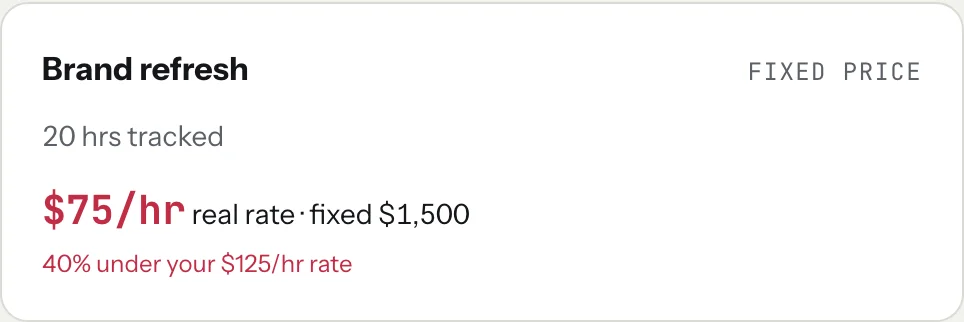
In tab, you add each package as a fixed-price project with its price and track time on it as usual. The project shows its real hourly rate as you go: the price divided by every hour tracked, next to your usual rate, in red when it runs more than 10% under.
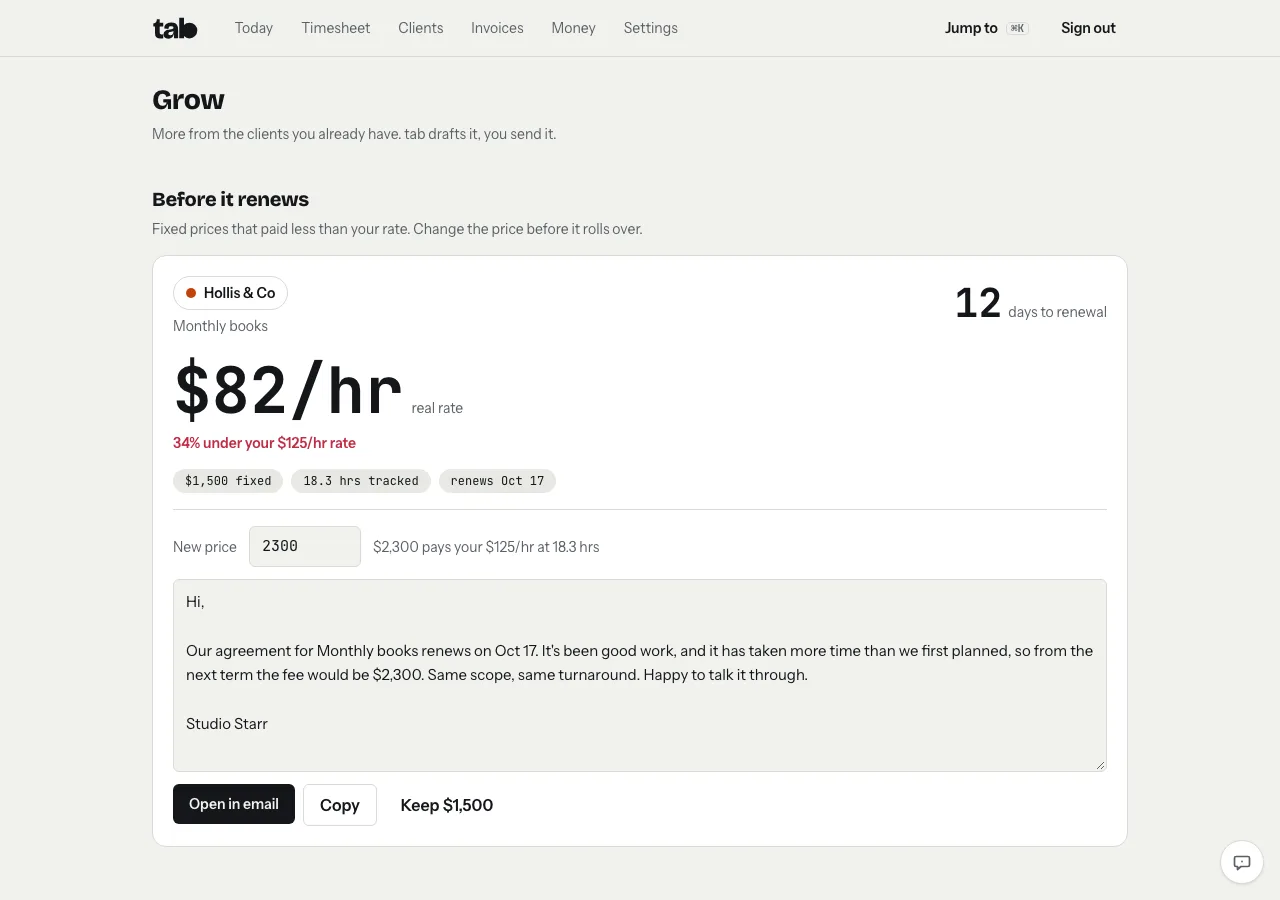
For a deposit, switch on "Bill in parts" on the project and tab offers each part as an invoice line in turn, so the first part can go out before any work is tracked. If a package renews, such as a monthly one, give the project a renewal date. When the price ran under your rate, tab's Grow page shows it before the renewal with a suggested new price and a drafted note you can send from your own email.
Not using an app yet? Put your numbers into the real rate page to see what a flat fee paid per hour, or read how to find your real hourly rate on flat-fee work.
Start the clock, no accountSign up free
When a client wants something in between
Some clients will ask for Best at the price of Better. Don't lower a price without removing something: "I can do that for $1,800 if we drop the social media set and keep two rounds of revisions." Trading scope, not rate, keeps every package honest. How to negotiate your rate has more wording for this.
And review your packages every few months. If almost everyone picks Good, the middle may be priced too far above it. If almost everyone picks Best, you may be undercharging for it.
Keep reading
 Negotiate your rateAnchor first, offer options, and trade scope instead of discounts. With wording you can copy.
 What goes into a freelance rateTax, costs, time off, unbilled hours and profit: the layers on top of your old hourly pay.
 Retainers and depositsGet paid before (or as) you work: deposits, monthly retainers, and the words to use.
Questions
What are good, better, best pricing packages?
Three versions of the same service at three prices. Good covers the essentials, Better is what most clients need, and Best adds more of what clients value, such as speed, extra deliverables or support.
How do I price freelance packages?
Estimate the hours each package takes, including calls, emails and file prep, multiply by your hourly rate, and round up. Build the middle package first, then remove items for the cheaper one and add items for the premium one.
Should the cheapest package just be a discount?
No. Make it smaller instead: fewer deliverables, fewer revision rounds, a longer turnaround. Then even the cheapest package still pays your rate.
How do I know if a package is underpriced?
Track your time on it for the first few clients and divide the price by the hours. If the result is well under your hourly rate, raise the price or take something out of the package.
See what each package really paid.
Add a package as a fixed price, track your time on it, and tab shows the real hourly rate as you go. Free to start, no account to try it.
Start free Try it, no sign-upFree to startNo cardNo screenshots, ever