Notes · pricing
What goes into a freelance rate, layer by layer
Your old hourly pay is only the bottom layer. Here is everything stacked on top of it, and a worked example you can redo with your own numbers.
Updated 2026-10-27
When you leave a job to freelance, the obvious move is to take your old hourly pay and charge that. It feels fair. It is also the most common way new freelancers end up working more and earning less than they did on payroll.
A freelance hourly rate is not one number. It is a stack of layers, like a slice of cake, and your old wage is only the bottom one. Each layer above it pays for something an employer used to cover without you noticing. Here is every layer, what goes into it, and a worked example you can redo with your own numbers.
Layer 1: the income you want to take home
Start with the yearly income you want, before income tax. If you are coming from a job, your old salary is a fair starting point. If you think in hourly pay, multiply by 2,080, which is a full-time year: 40 hours a week for 52 weeks.
Example: $40 an hour × 2,080 = $83,200 a year.
Not sure what your work pays on payroll? tab's rate guides list the median employee pay for 92 professions from official U.S. Bureau of Labor Statistics data, and turn each one into a freelance floor with the same layers below.
Layer 2: the tax your employer used to pay
An employee pays 7.65% of their wages toward Social Security and Medicare, and the employer quietly pays another 7.65% on top. When you work for yourself, you pay both halves. The IRS calls it self-employment tax: 15.3% in total, made up of 12.4% for Social Security and 2.9% for Medicare, and it applies once your net earnings from self-employment are $400 or more in a year. You can deduct the employer-equivalent half when you work out your adjusted gross income. Source: IRS, Self-employment tax.
Your old wage already covered your own 7.65%, so the new layer is the employer's 7.65% that nobody pays for you anymore.
Example: $83,200 × 1.0765 = $89,565.
Two more things change about tax. Nobody withholds it from your pay, and the IRS says people in business for themselves generally need to make estimated tax payments during the year, covering income tax and self-employment tax (IRS, Estimated taxes). The freelance tax calculator shows how much of each payment to set aside. This is general information, not tax advice; a tax professional can tell you what applies to you.
Layer 3: the costs a company used to cover
On payroll, someone else bought your laptop, your software, your health insurance and part of your retirement. Now those come out of your rate. List what you actually pay in a year:
- Health insurance and any retirement savings you want to match what a job offered.
- Software and subscriptions: design tools, accounting, cloud storage, your website.
- Equipment you replace every few years, divided across those years.
- Payment processing fees, an accountant, insurance, a coworking desk, courses.
The hourly rate calculator and the rate guides use $9,000 a year as a starting default. Replace it with your own total.
Example: $89,565 + $9,000 = $98,565 a year that your billable hours have to earn.
Layer 4: time off, which nobody pays for now
Holidays, vacation and sick days were paid in a job. As a freelancer, a week off is a week with no invoice. So decide how many weeks a year you will not bill, and take them out before you divide. The default in tab's tools is 6 weeks off, which leaves 46 working weeks.
Layer 5: the hours you work but can't bill
This is the layer that surprises people most. Writing proposals, answering email, invoicing, chasing payments, bookkeeping, learning new tools and finding the next client are all real work, and no client pays for them. A 40-hour week might hold 25 hours you can actually bill.
The tools default to 25 billable hours a week. The honest way to find your own number is to track everything for a few weeks, billable or not, and look at the split. In tab you can mark any entry as not billable, so admin time still shows up without landing on an invoice.
Example: 25 billable hours × 46 weeks = 1,150 billable hours a year, not 2,080.
Put the slice together
Now divide what the year has to earn by the hours you can bill:
$98,565 ÷ 1,150 = about $86 an hour.
That is the freelance floor for someone who earned $40 an hour as an employee. More than double, and every dollar of the difference is already spoken for: the employer's tax share, your costs, your weeks off and your unbilled hours. Charging $40 would mean taking a large pay cut while doing the same work plus running a business.
This is exactly the formula behind every rate guide: employee pay × 2,080, plus the 7.65% employer share, plus yearly costs, divided by billable hours a week over your working weeks. Change any of the inputs in the freelance hourly rate calculator and the result updates as you type.
The top layer: profit
The floor only gets you back to where you were. A business also needs a margin above it: a buffer for slow months, money to invest in better tools, and room for the jobs that take longer than planned. The formula above does not add one for you, so add it on purpose. If you decide on 20%, for example, the $86 floor becomes about $103.
Things that justify charging well above the floor: specialist skills, rush timelines, work that is worth a lot to the client, and a track record in their industry. Things that don't change it: the client's budget, or what someone on a marketplace charged. When a client pushes back, the guide to negotiating your rate covers how to hold it.
Check the rate you actually earned
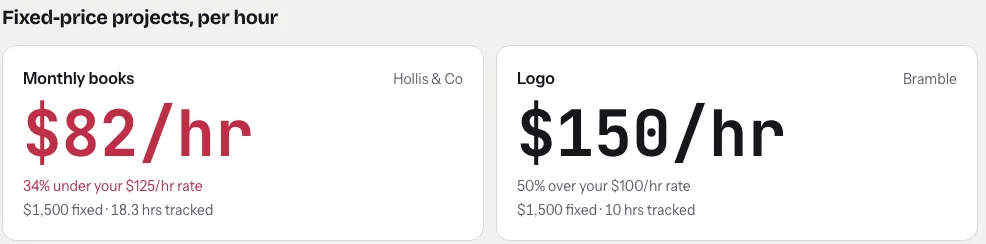
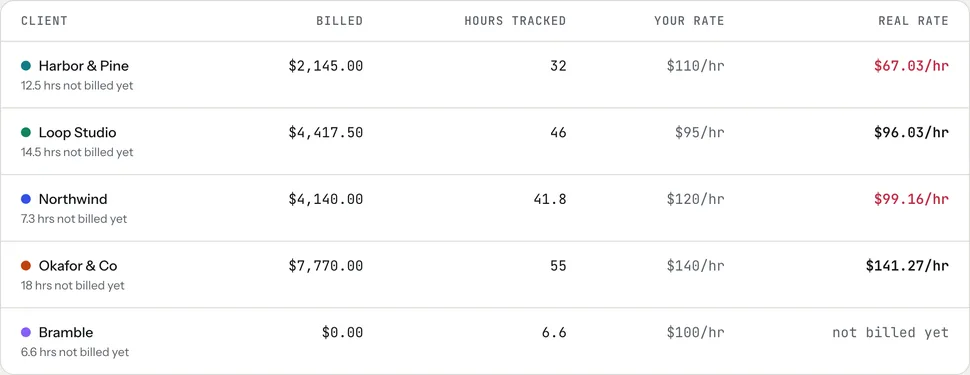
A rate on paper only matters if the hours behind it are real. Fixed-price projects are where it slips most: a $1,500 job that takes 18 hours instead of 12 quietly drops your hourly pay. tab works out what each project and client really paid per hour, from every hour you tracked, and turns the number red when it falls more than 10% below your rate.
The same check works per client, across everything you billed them:
If you want to see this for a past project before signing up, the real rate page explains how it works, and the meter on the homepage tracks time against your rate right in the browser, no account needed.
Start the clock, no accountSign up free
Checked October 26, 2026. Tax figures are from the IRS pages linked above. The worked example uses tab's calculator defaults; your own costs, time off and billable hours will change the result.
Keep reading
 Negotiate your rateAnchor first, offer options, and trade scope instead of discounts. With wording you can copy.
 Retainers and depositsGet paid before (or as) you work: deposits, monthly retainers, and the words to use.
 Your real hourly rateFlat fee ÷ every hour it took. How to count honestly, and what to do when it's low.
Questions
How do I turn my salary into a freelance hourly rate?
Add the 7.65% employer share of Social Security and Medicare and your yearly business costs to the salary, then divide by the hours you can actually bill in a year: billable hours a week times the weeks you will work. That gives you a floor; add a profit margin on top.
Why is a freelance rate so much higher than an employee's hourly pay?
Because it pays for things an employer used to cover: the employer's half of Social Security and Medicare, health insurance, equipment and software, paid time off, and all the hours spent on admin and finding clients that no one bills for.
How many billable hours a week should I plan for?
Fewer than you work. tab's tools start at 25 billable hours a week, but the honest answer comes from tracking everything, billable or not, for a few weeks and looking at the split.
What is self-employment tax?
It is Social Security and Medicare tax for people who work for themselves. The IRS rate is 15.3%: 12.4% for Social Security and 2.9% for Medicare. It applies when net earnings from self-employment are $400 or more, and you can deduct the employer-equivalent half when working out adjusted gross income.
See the rate you really earn.
tab tracks time per client at your rate and shows what each project actually paid per hour. Free to start, no account to try it.
Start free Try it, no sign-upFree to startNo cardNo screenshots, ever