Notes · pricing
Insert coin: retainers and deposits for freelancers
How to get part of the money before you start, or each month as you go, and the words to put in your proposal.
Updated 2026-10-27
An arcade game doesn't start until you insert a coin. Most freelancers work the other way around: do all the work, send an invoice, then wait weeks to be paid. That's a lot of risk to carry for a client you may have met last month.
Deposits and retainers flip some of that risk back. With a deposit, part of the money arrives before you start. With a retainer, the client pays at the start of each month for work in that month. Both are normal business arrangements, and clients who are serious about a project rarely object to them. Here is how each one works, how to set it up, and the words to use.
Deposits: part of the fee before you start
A deposit is a share of a project's price, paid up front. It's most common on fixed-price projects: a website, a logo, a set of illustrations. The usual shape is simple:
- Half up front, half on delivery. Easy to explain and fair to both sides.
- Thirds for longer projects: a third to start, a third at a midpoint you both agree on, a third on delivery.
- A fixed amount to book your time, for example to hold a start date.
The deposit does three jobs. It pays you for the early work, which is often the hardest part. It confirms the client is committed. And it tests the payment process: if paying a deposit takes three weeks, you've learned something before doing the work.
How to ask for a deposit
Put it in the proposal as a plain fact, not a request:
"Work starts once the first invoice is paid" is the important line. It's polite, and it means you never begin on a promise.
Retainers: paid each month for ongoing work
A retainer is a regular payment, usually monthly, for ongoing work with one client. It suits work that repeats: a monthly newsletter, bookkeeping, site updates, social posts, being on call for design or development questions. There are two common types:
- Fixed scope, fixed fee. "Four newsletters a month for $[amount]." The client knows the price and you know the work. The risk is scope slowly growing.
- Prepaid hours. "Up to 10 hours a month at $[rate], billed at the start of the month." The client gets priority on your time, and you track hours against the block.
Either way, the payment comes at the start of the month, before the work. That's what makes a retainer different from an ongoing hourly client who pays later.
Write the rules down
A retainer is easy to agree to and easy to argue about later. Settle these in writing before the first month:
- What's included, as specifically as you can: number of deliverables, or number of hours.
- When it's billed and due, for example invoiced on the 1st, due on the 7th.
- What happens to unused hours. Roll over to next month, roll over with a cap, or expire. Any of these is fine if it's agreed in advance.
- What happens with extra work. Usually billed at your hourly rate, after you tell the client.
- How either side ends it, for example 30 days' notice.
In some places a written contract is required anyway. In New York City, for example, contracts worth $800 or more (including work that adds up to $800 within 120 days) must be in writing and must spell out the work, the pay and the date you get paid (NYC Department of Consumer and Worker Protection).
A note on taxes
Most freelancers use the cash method of accounting. Under it, the IRS says you include in income "all items of income you actually or constructively received during the tax year" (IRS Publication 538). So a deposit paid in December generally counts for the year you received it, even if you do the work in January. Set the tax share aside when the money lands, not when the project ends. The freelance tax calculator helps you estimate it.
Checked October 26, 2026. General information, not tax or legal advice.
Setting it up in tab
tab doesn't have a separate retainer feature, but its fixed-price projects cover the common cases:
- A deposit: add a fixed-price project and switch on "Bill in parts". It starts as a 50/50 split you can rename and change. When you close the tab for that client, tab offers the next open part as an invoice line, so you can send the deposit before any work is tracked, and the second part when you deliver.
- A monthly fixed fee: a fixed-price project with a renewal date. You track time on it like any other work, and tab shows what the fee really paid per hour. If it ran under your rate, tab reminds you before it renews, with a suggested new price.
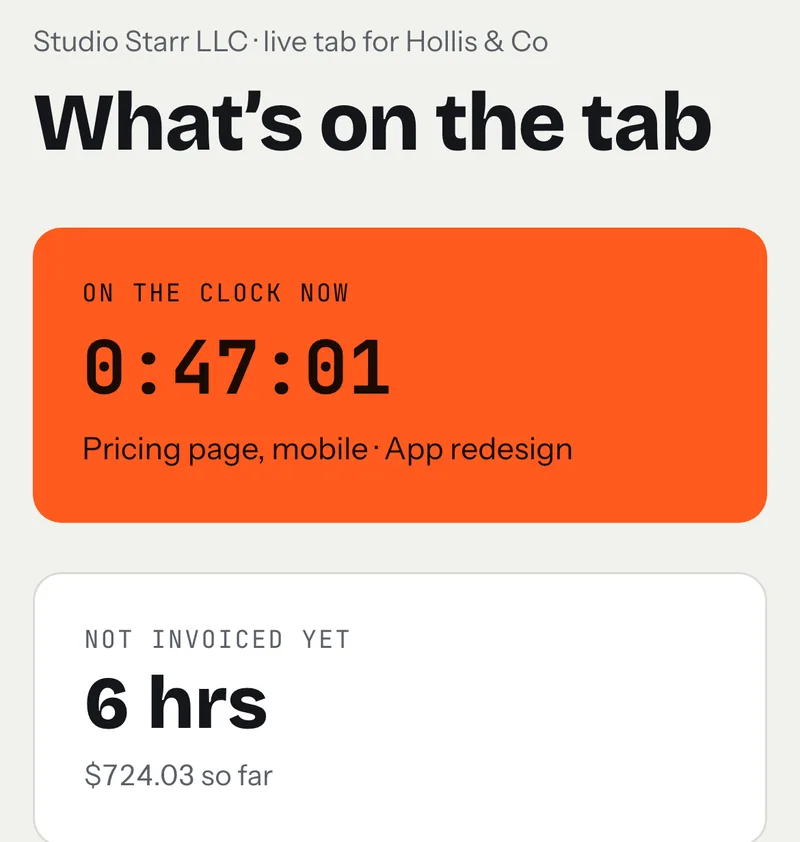
- Prepaid or ongoing hours: track time on an hourly project and give the client their live tab, a private link showing the hours not yet invoiced, the total so far, and any open invoices with pay links.
Clients pay online by bank transfer or card, into your own Stripe account. When a deposit is paid, tab emails you what came in and what you actually get after fees:
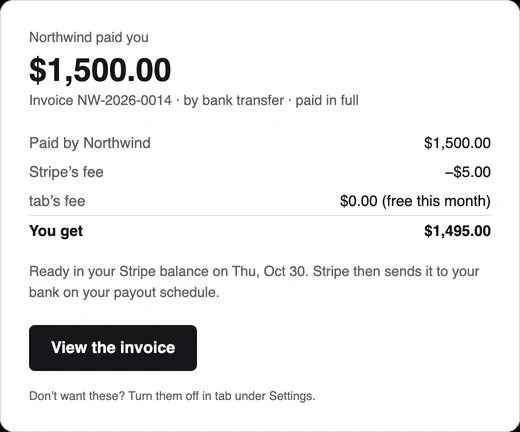
tab takes no fee on the first $2,000 collected online each calendar month, then 1% up to $10,000 and 0.5% above that. Stripe's own processing fee is separate; in the US it's 0.8% capped at $5 by bank transfer, or 2.9% + 30¢ by card (Stripe pricing). Payments you receive outside tab are always free. The payment fee calculator shows the difference on any amount.
Checked October 26, 2026.
Start the clock, no accountSign up free
When a client says no
Some clients, often larger companies, can't pay before work starts because of how their accounts payable works. You have options short of walking away:
- Smaller first part. Offer a short paid first phase, like a discovery or audit, invoiced and paid before the main project.
- Shorter cycles. Invoice every two weeks instead of at the end, so you're never far ahead of payment.
- Clear due dates and a follow-up plan if they slip. Following up on an unpaid invoice has a schedule and wording.
And if a client won't pay anything until the very end of a long project, treat that as a signal about how the rest of the relationship may go.
Keep reading
 Negotiate your rateAnchor first, offer options, and trade scope instead of discounts. With wording you can copy.
 What goes into a freelance rateTax, costs, time off, unbilled hours and profit: the layers on top of your old hourly pay.
 Your real hourly rateFlat fee ÷ every hour it took. How to count honestly, and what to do when it's low.
Questions
How much deposit should a freelancer ask for?
Half up front and half on delivery is the most common and easiest to explain. Longer projects are often split into thirds. Whatever you choose, write it in the proposal and start work once the first invoice is paid.
What's the difference between a retainer and a deposit?
A deposit is a share of one project's price paid before you start. A retainer is a regular payment, usually monthly, for ongoing work, paid at the start of each period.
What happens to unused retainer hours?
Whatever you agree in writing beforehand. Common choices are rolling them over, rolling over with a cap, or letting them expire at the end of the month.
Can I invoice a deposit in tab?
Yes. Add a fixed-price project and switch on Bill in parts. tab offers the next open part as an invoice line, so you can send the first part before any work is tracked.
Get the first part paid before you start.
Split a fixed price into parts, send the deposit invoice, and let the client pay online by bank or card. Free to start, no account to try it.
Start free Try it, no sign-upFree to startNo cardNo screenshots, ever