Notes · money & taxes
Folded away for later: planning for a slow season
A cash buffer, a pipeline you keep warm, and the clients who already know you. A plan to make in the busy months.
Updated 2026-10-27
Freelance work rarely arrives evenly. A few months are packed, then a client's budget runs out, a holiday stretch goes quiet, or two projects end in the same week. The first slow month is often a shock. After that, the freelancers who stay calm are the ones who planned for it while the busy months were still going, the way you fold the sweaters away in spring knowing you'll need them again.
A slow season can't always be avoided. Being caught out by one usually can. Here is a plan with three parts: a cash buffer, a pipeline you keep warm, and the clients who already know you.
Step 1: Know what a month costs you
Before you can plan for a slow month, you need one number: what it costs to keep going for a month with no income. Add up:
- Personal costs you have to cover: rent or mortgage, food, insurance, debt payments.
- Business costs that don't stop: software subscriptions, phone and internet, any coworking space.
- Tax you'll still owe on money you already earned (more on that below).
Write the total down. That's your monthly floor. Everything in this plan is measured against it.
Step 2: Build a buffer in the good months
A buffer is money set aside only for months when income falls below your floor. Pick a target, for example two or three months of your floor, and build it a little at a time. The easiest way is a fixed habit: every time a client pays, move a set share into a separate savings account before you spend any of it.
Two other set-asides should happen at the same moment, so they never get mixed up with the buffer:
- Tax. In the US, if you expect to owe $1,000 or more in tax when you file, you generally have to pay estimated tax during the year, split into four payment periods (IRS: Estimated taxes). Self-employment tax is 15.3% on top of income tax (IRS: Self-employment tax). A quiet month doesn't cancel a payment that's due on what you earned in a busy one. The freelance tax calculator gives a rough share to set aside.
- Fees. What a client pays isn't quite what reaches you. Card and bank transfer fees come out first, so plan from the amount that lands.
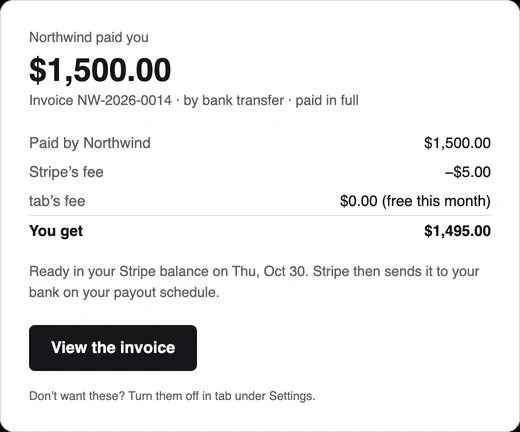
In tab, the Money page shows what you collected this month and a tax set-aside (25% unless you change it, right there on the page), so the split is already worked out each time money lands.
Checked October 26, 2026. General information, not tax advice; a tax professional can tell you what your own set-aside should be.
Step 3: Keep the pipeline warm while you're busy
The cruel part of freelancing is that the time you most need new work is weeks after you stopped looking for it. When you're fully booked, finding the next job feels unnecessary. Then the projects end together and there's nothing lined up.
The fix is small and regular, not big and occasional. Pick one short block a week, even during busy stretches, for things that bring work later:
- Reply to one or two posts or job listings that fit you well.
- Share one piece of finished work (with the client's permission) where people who hire you can see it.
- Ask a happy client if they know anyone who needs what you do.
Watch the end dates on your current projects too. If three of them finish in the same month, that month is your slow season, even if it's six weeks away.
Step 4: Go back to past clients first
The fastest work in a slow month usually comes from people who have already hired you and paid you. They know your work, they trust you, and there is no proposal to win. Often they simply haven't thought of a next project yet.
A short, specific note works better than "just checking in":
Be honest about having room, but keep it about their needs. One note per client, then leave it for a couple of months.
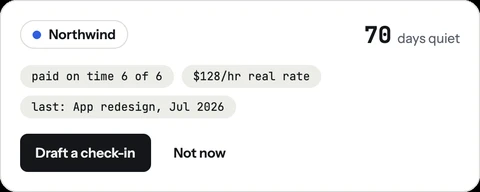
tab's Grow screen does the remembering for you. Under "Who to go back to" it lists clients who have paid you before and gone quiet (no time or invoice for at least 30 days), best first, with how reliably they paid, the real rate you earned with them, and their last project. It drafts a check-in note that you send from your own email. Read more on the past clients page.
Start the clock, no accountSign up free
Step 5: Use the quiet time on purpose
If a slow month comes anyway, it doesn't have to be wasted. Some useful things that are hard to do when busy:
- Fix your prices. Look at the real hourly rate of last season's projects and decide what to charge next time. The hourly rate calculator and the rate guides help you check the number.
- Update your portfolio with the work you were too busy to write up.
- Learn the skill clients kept asking for.
- Set up steadier income. A monthly arrangement with one or two good clients smooths out the dips. Retainers and deposits explains how to set one up.
A short checklist
- Know your monthly floor.
- Every payment: tax first, then buffer, then the rest.
- One short block a week for finding the next work, even when busy.
- Watch when your current projects end.
- In a quiet month, write to past clients first.
Keep reading
 A separate business accountWhy the IRS says to keep business money apart, and how to set it up in an afternoon.
 An emergency fund, freelance styleYour monthly floor, a target in months, and a share of every payment until it's full.
 Eight weeks leftA week-by-week year-end plan: bill everything, invoice before the holidays, get taxes ready.
Questions
How much should a freelancer save for slow months?
Start by working out what one month with no income costs you, then set a target of a few months of that. Build it with a fixed share of every payment, kept separate from your tax savings.
Do I still have to pay estimated taxes in a slow month?
Usually, yes. US estimated tax is based on what you earned, split into four payment periods, so a payment can fall due in a quiet month for money earned in a busy one. That's why tax money should be set aside as soon as each payment arrives.
How do I find work fast when things are slow?
Write to past clients who paid you well. They already trust you and there is no proposal to win. A short note that mentions your last project and says you have room in your schedule is enough.
How can I avoid a slow season in the first place?
Keep looking for work in small weekly blocks while you're busy, watch when your current projects end, and set up monthly arrangements with one or two clients to smooth out the dips.
See what landed, and who to call next.
tab tracks your hours, gets you paid, works out the tax share, and reminds you which good clients have gone quiet. Free to start, no account to try it.
Start free Try it, no sign-upFree to startNo cardNo screenshots, ever