Notes · money & taxes
Eight weeks left: a year-end plan for freelancers
A week-by-week plan for the rest of 2026: bill everything, invoice before the holidays, and get taxes ready for January 15.
Updated 2026-10-27
From the first week of November there are about eight weeks left in the year. For a freelancer that's less time than it sounds: Thanksgiving falls on November 26, Christmas on a Friday, and the people who approve invoices take time off in the last two weeks of December. Work you finish in that stretch can easily turn into money you don't see until February.
This is a week-by-week plan for the rest of 2026: get everything invoiced while people are still at their desks, sort out taxes before the January deadline, and go into the holidays knowing what you're owed. Tax details are for US freelancers, and they're general information, not tax advice.
Weeks 1 and 2 (November 2 to 15): find and bill everything
Start with money you've already earned.
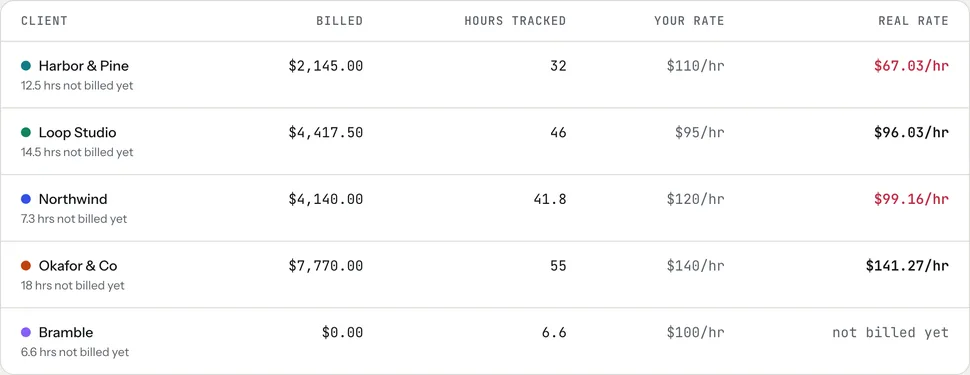
- Bill every unbilled hour. Go client by client and invoice everything not yet billed, even small amounts. Finding your unbilled hours shows where they hide.
- Chase what's overdue. Anything past due should get a polite follow-up now, not in December. Following up on an unpaid invoice has the schedule and wording.
- Send next year's rates. If your rate goes up in January, tell clients now, with 30 to 60 days' notice. How to raise your rates has the letter.
Weeks 3 and 4 (November 16 to 29): tell clients your December
- Share your holiday schedule. Tell every active client which days you're off in late December and early January, and the last day to send you work before the break. Clients plan better with dates than with "I'll be around".
- Set a last invoice date. Pick a day in mid-December to send your final invoices of the year, and tell clients it's coming. Before Thanksgiving week is a good time to say so. Telling clients your December schedule has more on this.
- Check deadlines on open projects. If a project can't realistically finish before the break, agree a January date now rather than rushing it.
Weeks 5 and 6 (November 30 to December 13): invoice before the slowdown
This is the most important stretch. Send invoices while the person who approves them is still working.
- Invoice in early December, not on December 31. An invoice sent on December 30 can sit in a closed office until January.
- Bill fixed-price work in parts. If a project will run into January, invoice the part that's done now.
- Ask about payment runs. Some larger companies have a last payment date before the holidays. Ask your contact when it is, and send your invoice before it.
Why the date you get paid matters for taxes
If you use the cash method of accounting, you include income in the tax year you actually or constructively received it (IRS Publication 538). So a payment that arrives on December 28 generally counts for 2026, and one that arrives on January 4 counts for 2027, even for the same work. That changes how much tax you owe in each year, so know which year each payment will land in.
Weeks 7 and 8 (December 14 to 27): taxes and records
Before you log off for the holidays, get the paperwork ready for January.
- Work out your last estimated tax payment. Individuals, including sole proprietors, generally have to make estimated tax payments if they expect to owe $1,000 or more when they file (IRS, Estimated taxes). The fourth payment for 2026 is due January 15, 2027. You don't have to make that payment if you file your 2026 return by February 1, 2027 and pay the entire balance due with it (IRS Form 1040-ES, 2026).
- Know which forms are coming. A business that paid you at least $2,000 for services in 2026 generally files a Form 1099-NEC for you, with a copy to you, by January 31 (IRS, Instructions for Forms 1099-MISC and 1099-NEC). Make a list of clients you expect one from, and check each one against your own records when it arrives. W-9s and 1099s for freelancers explains the forms.
- Gather the year's records. Invoices, payments, receipts for business costs. Freelance record keeping lists what to keep and for how long.
- Check the set-aside. Compare what you've put aside for tax with an estimate of what you'll owe. The freelance tax calculator gives a starting number and lists the payment dates.
Checked October 26, 2026. General information, not tax advice; a tax professional can tell you what applies to you.
Where tab helps
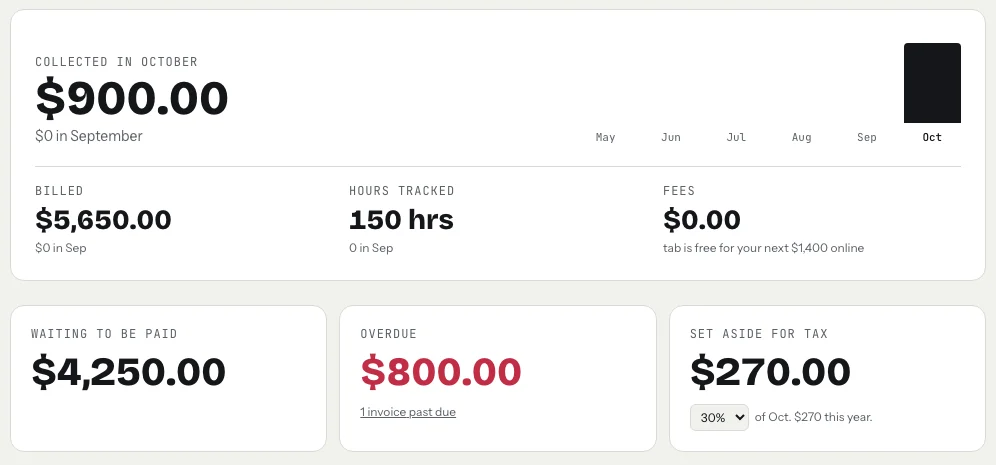
tab's Money screen shows the year's money in one place: what you collected and billed this month, what's waiting to be paid, what's overdue, and how much to set aside for tax. The tax percentage is set right on that screen and starts at 25%, so you can change it to match your own estimate.
When it's time to hand things to your accountant, everything exports as spreadsheets: time entries, invoices, payments and clients, free on every plan.

And for the hours you'll work between now and the break, the meter on the homepage tracks them without an account, so nothing from December slips into next year unbilled.
Start the clock, no accountSign up free
One page to keep
- November 2 to 15: bill every unbilled hour, chase overdue invoices, send next year's rates.
- November 16 to 29: tell clients your holiday dates and your last invoice date.
- November 30 to December 13: send invoices before offices slow down.
- December 14 to 27: estimate the January 15 payment, list expected 1099s, gather records.
Then take the break. In January, start the year with a quarterly look back.
Keep reading
 Planning for a slow seasonYour monthly floor, a buffer from the good months, and the past clients to write to first.
 A separate business accountWhy the IRS says to keep business money apart, and how to set it up in an afternoon.
 An emergency fund, freelance styleYour monthly floor, a target in months, and a share of every payment until it's full.
Questions
When is the last estimated tax payment for 2026?
January 15, 2027. According to Form 1040-ES, you don't have to make that payment if you file your 2026 return by February 1, 2027 and pay the entire balance due with it.
Does a payment received in January count for last year's taxes?
Under the cash method of accounting, income counts in the year you actually or constructively receive it. A payment that arrives in January 2027 generally counts for 2027, even if the work was done in December.
When should freelancers send their last invoices of the year?
In early to mid-December, before clients slow down for the holidays. Ask larger clients when their last payment run is, and send your invoice before it.
Will my clients send me a 1099-NEC?
A business that paid you at least $2,000 for services in 2026 generally has to file a Form 1099-NEC and send you a copy by January 31. Check each one against your own records.
Finish the year with nothing unbilled.
tab shows every unbilled hour per client, turns it into an invoice your client pays online, and keeps the tax set-aside in view. Free to start, no account to try it.
Start free Try it, no sign-upFree to startNo cardNo screenshots, ever