Notes · money & taxes
A client asked for a W-9. Here's what it means
How to fill in a W-9 safely, what the 1099-NEC that follows it means, and the threshold that changed for payments made in 2026.
Updated 2026-10-27
A new client says yes, and then their accounts team emails: "Before we can pay you, please send a completed W-9." If it's your first one, it can feel like you've done something wrong. You haven't. It's one of the most routine pieces of paperwork in US freelancing, and it takes about five minutes.
This note explains what a W-9 is, how to fill it in safely, and what the 1099-NEC form that often follows it means for you, including the reporting threshold that changed for payments made in 2026. It's general information for US freelancers, not tax advice. If your situation is complicated, a tax professional is worth the fee.
What a W-9 is, and why clients ask for it
The IRS describes Form W-9 simply: you use it "to provide your correct Taxpayer Identification Number (TIN) to the person who is required to file an information return with the IRS" (IRS, About Form W-9). In plain words: your client may have to tell the IRS how much they paid you, and they need your legal name and tax number to do it.
A few things to know:
- You give it to the client, not to the IRS. The form itself says "Give form to the requester. Do not send to the IRS."
- It's normal to send it before your first invoice is paid. Many companies won't set you up for payment without one.
- The current version is dated March 2024. Download it from irs.gov rather than using an old copy a client attaches.
How to fill it in
Most solo freelancers only need a handful of lines (Form W-9, Rev. March 2024):
- Line 1, your name. For a sole proprietor, the form says to enter the owner's name here, meaning you.
- Line 2, business name, only if you use one that's different, such as a trade name or a single-member LLC's name.
- Line 3a, tax classification. Most freelancers without a company tick "Individual/sole proprietor".
- Lines 5 and 6, your address.
- Part I, your tax number. For individuals this is generally your Social Security number. The form also says: "If you are a sole proprietor and you have an EIN, you may enter either your SSN or EIN."
- Part II, sign and date.
Consider a free EIN
An EIN (employer identification number) is a business tax number from the IRS. Many sole proprietors get one so they don't have to put their Social Security number on every client's form. It's free: the IRS warns "You never have to pay a fee for an EIN," and you can apply online (IRS, Get an EIN). Be wary of websites that charge for one.
Send it safely
A completed W-9 holds your tax number, so treat it like a bank detail. Use the client's secure upload or vendor portal if they have one, or ask how they'd like to receive it. And only send it to a client you've actually agreed to work with.
What if you don't send it?
The W-9 explains that people paying you may, under certain conditions, have to withhold 24% of payments and send it to the IRS. This is called backup withholding. Among the reasons the form lists: you don't give the requester your tax number, or the IRS tells them the number you gave is incorrect. A correct, signed W-9 avoids that.
Checked October 26, 2026. General information, not tax advice.
Then comes the 1099-NEC
After the year ends, a business client who paid you enough may send you a Form 1099-NEC, which reports nonemployee compensation: what they paid you for your work. The key rules, from the IRS:
- The threshold changed. "For payments made before 2026, the reporting threshold is $600. For payments made in 2026, the reporting threshold is $2,000" (IRS, Am I required to file a Form 1099). The IRS instructions add that the $2,000 amount applies to tax years beginning after 2025 and "may be adjusted for inflation beginning in calendar year 2027" (IRS, Instructions for Forms 1099-MISC and 1099-NEC). So a client who paid you $1,500 in 2026 generally doesn't have to send you a 1099-NEC, where under the old $600 rule they would have.
- The deadline is January 31. The same instructions say the client furnishes your copy and files with the IRS by January 31.
- Card payments are different. Payments made with a credit card or payment card, and certain third-party network transactions, "must be reported on Form 1099-K by the payment settlement entity" and aren't reported on a 1099-NEC (same instructions). A client who paid you by card generally won't include that on a 1099-NEC.
- Payment apps have their own threshold. For third party settlement organizations such as payment apps and online marketplaces, the IRS says a 1099-K is issued when your payments for goods or services "exceeds $20,000 in more than 200 transactions" (IRS, Understanding your Form 1099-K).
The most important part: no form doesn't mean no tax
The higher threshold changes what clients must send, not what you owe. The IRS is clear that even without a form "you must still report any income on your tax return" (IRS, Form 1099-K). And you generally have to file a return if your net earnings from self-employment were $400 or more (IRS, Self-employed individuals tax center). With fewer 1099s arriving from 2026, your own records become the main proof of what you earned.
Checked October 26, 2026. General information, not tax advice. Rules can change; check irs.gov or ask a tax professional for your situation.
What to do in January
- Add up what each client paid you during the calendar year, from your own records.
- Compare each 1099 that arrives against that total. If one looks wrong, write to the client and ask them to correct it.
- Report all of it, with or without a form. Freelance record keeping covers what to keep and for how long.
Keeping it straight in tab
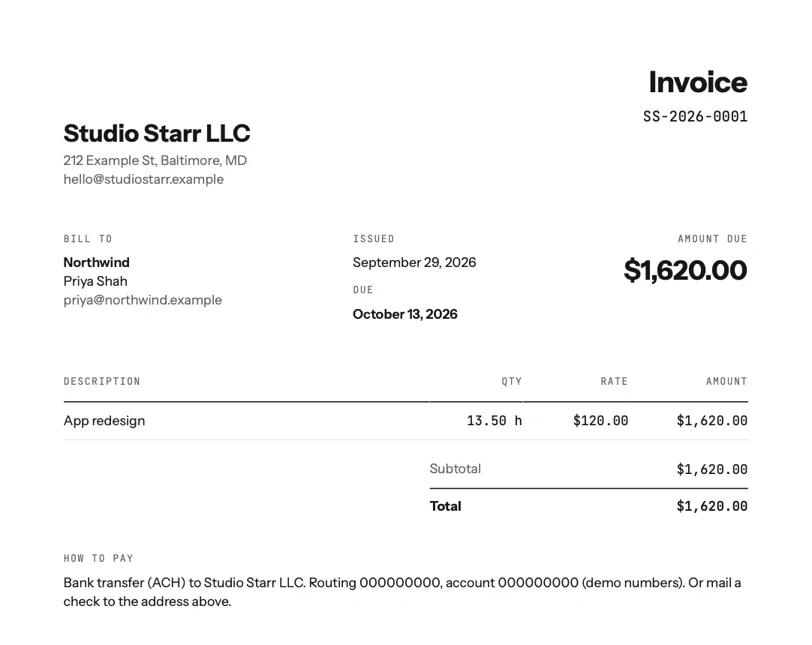
tab won't fill in tax forms for you, but it keeps the records you'll check them against. In Settings, you set the name on your invoices, your address and an optional tax ID, and they appear on your invoice PDFs. If you list a tax number there, an EIN is a better choice than your Social Security number.
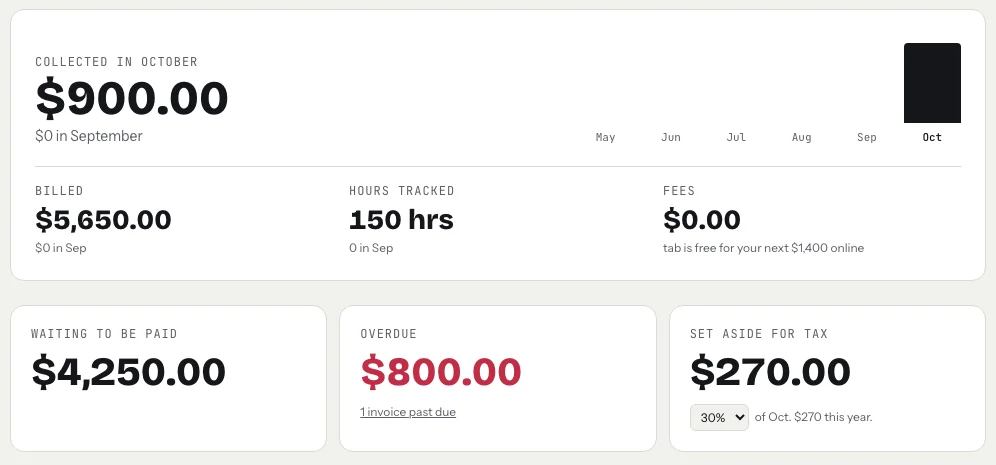
The Money screen shows what you've collected each month and a running amount to set aside for tax, and you can export invoices and payments as CSV for your accountant at any time.
To estimate the tax on what you've earned, try the freelance tax calculator. If clients pay by card, the payment fee calculator shows what lands after fees, and the quarterly look back is a good moment to check your numbers before each estimated payment.
Keep reading
 Planning for a slow seasonYour monthly floor, a buffer from the good months, and the past clients to write to first.
 A separate business accountWhy the IRS says to keep business money apart, and how to set it up in an afternoon.
 An emergency fund, freelance styleYour monthly floor, a target in months, and a share of every payment until it's full.
Questions
Why is my client asking me for a W-9?
Because they may have to report what they paid you to the IRS. The W-9 gives them your legal name and taxpayer identification number. You send it to the client, not to the IRS.
What is the 1099-NEC threshold for 2026?
The IRS says the reporting threshold is $600 for payments made before 2026 and $2,000 for payments made in 2026. The $2,000 amount may be adjusted for inflation beginning in 2027.
Do I have to report income if I don't get a 1099?
Yes. The IRS says you must still report the income on your tax return even if you don't receive a form. Your own invoices and payment records are what you report from.
Should I use my Social Security number or an EIN on a W-9?
A sole proprietor may enter either one if they have an EIN, according to the form. Many freelancers get a free EIN from the IRS so they don't share their Social Security number with every client.
Know what every client paid you.
Invoices with your legal name, payments by month, a tax set-aside and a CSV for your accountant. Free to start, no account to try it.
Start free Try it, no sign-upFree to startNo cardNo screenshots, ever