Notes · money & taxes
The life ring on the hook: an emergency fund for uneven income
How big to make it, where to keep it, how to fill it when no two months look alike, and the rules for when you can use it.
Updated 2026-10-27
A life ring hangs on its hook by the water every day, doing nothing. That's the point. Nobody questions why it's there, and nobody takes it down to use as a chair. An emergency fund works the same way: money that sits ready for the day something goes wrong, and isn't touched otherwise.
For freelancers, "something goes wrong" has more shapes than it does for an employee. A client pays 40 days late. Your laptop dies in the middle of a project. Your biggest client cuts its budget. You're sick for two weeks and nobody pays you for those days. Here is how to size a fund for uneven income, where to keep it, how to fill it without feeling it, and the rules for when you're allowed to use it.
This is general information, not financial or tax advice.
Step 1: find your monthly floor
Size the fund from your costs, not your income. Add up what you must pay in a normal month, even if no work comes in:
- Rent or mortgage, utilities, food, insurance, minimum debt payments.
- The business costs that don't stop: software, phone, internet, your accountant.
- Health insurance, if you buy your own. Open enrollment for the self-employed covers how to price it.
Use your bank statements, not memory. The total is your monthly floor. Leave out things you could pause for a few months, like takeout or a gym membership. This is the number the fund protects.
Step 2: pick a target in months
A fund is measured in months of your floor. There's no official number; choose based on how risky your income is:
- One month is the first milestone. It turns one late invoice from a crisis into an inconvenience.
- Three months covers most bad stretches: a lost client, a slow season, a few weeks off sick.
- Six months or more makes sense if one client pays most of your income, your work is seasonal, or someone else depends on your income.
For example: a floor of $3,000 a month means a first goal of $3,000 and a longer goal of $9,000. Write both numbers down. A target you can see is much easier to fill than "some savings".
Step 3: keep it in its own place
The fund needs to be easy to reach in a day or two, safe, and out of sight of your everyday spending. A separate savings account does all three. If you already keep business and personal money apart, add one more account for the fund, and give it a plain name like "Emergency only".
Keep it at an insured bank. The FDIC's standard insurance amount is $250,000 per depositor, per insured bank, for each account ownership category (FDIC, Deposit Insurance at a Glance). Avoid putting the fund anywhere its value can drop right when you need it.
Checked October 26, 2026.
Step 4: fill it a payment at a time
Uneven income makes "save $500 a month" hard, because some months there isn't $500 to spare. A percentage works better: every time a client pays, move a set share into the fund the same day, before you spend any of it. In a good month the fund grows quickly; in a thin one it grows a little.
The order matters. When a payment lands:
- Tax first. Nobody withholds tax from a client payment. The IRS says individuals, including sole proprietors, generally have to make estimated tax payments if they expect to owe $1,000 or more when they file (IRS, estimated taxes). That money isn't yours to save or spend. The freelance tax calculator gives a starting share.
- Then the fund, for example 10% of what's left, until you hit your target.
- Then everything else.
Checked October 26, 2026. General information, not tax advice.
tab's Money screen puts the numbers you need in one place: what you collected this month, what's still waiting to be paid, what's overdue, and how much to set aside for tax at the percentage you choose.
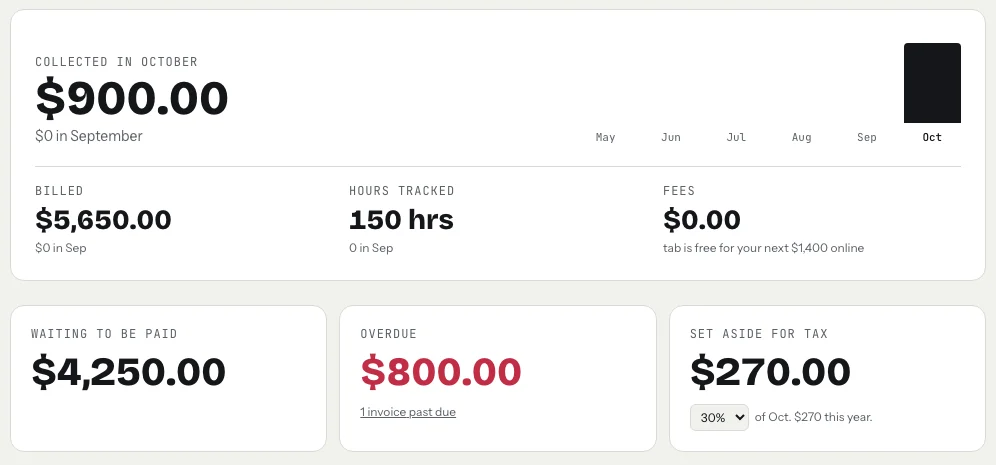
Look at the gap in that sample: $5,650 billed, but only $900 collected. That's the situation an emergency fund is for. The work is done and the money is coming, just not this week.
Step 5: decide the rules before you need them
A fund that's used for anything stops being a fund. Write down, once, what counts:
- Yes: income below your floor this month, a late payment that leaves you short, a broken laptop or other tool you need to work, a medical bill, a few weeks you can't work.
- No: a holiday, an upgrade you want but don't need, a tax bill you should have set aside for. (If that last one happens, use the fund, then raise your tax percentage.)
And one rule for afterwards: when you take money out, the next payments refill it first, at a higher share than usual, until it's back to target.
Make emergencies less likely, too
The fund catches you when something goes wrong. A few habits make it go wrong less often:
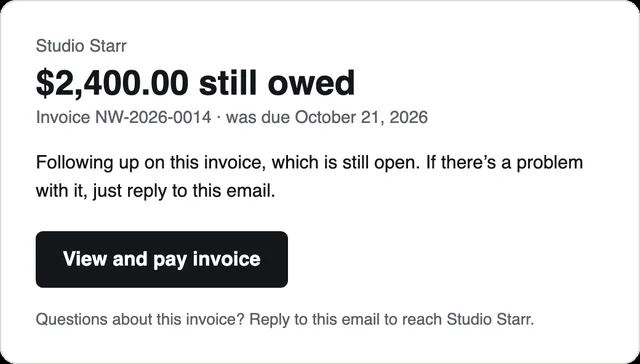
- Invoice promptly and chase politely. Short payment terms and quick reminders bring money in sooner. tab can send overdue reminders at 3, 10 and 21 days past the due date, switched on per client, from you, with the pay link.
- Ask for deposits on project work, so part of the money arrives before you start. Retainers and deposits shows how.
- Don't depend on one client. If one client is most of your income, losing them is an emergency by definition. Juggling several clients helps you grow beyond one.
Start the clock, no accountSign up free
The short version
Know your monthly floor. Aim for one month first, then three or more. Keep it in its own insured savings account. Fill it with a share of every payment, after tax. Decide what counts as an emergency before one happens, and refill it first afterwards. For the longer-range plan around quiet months, see planning for a slow season.
Keep reading
 Planning for a slow seasonYour monthly floor, a buffer from the good months, and the past clients to write to first.
 A separate business accountWhy the IRS says to keep business money apart, and how to set it up in an afternoon.
 Eight weeks leftA week-by-week year-end plan: bill everything, invoice before the holidays, get taxes ready.
Questions
How big should a freelancer's emergency fund be?
Measure it in months of your essential costs. One month is a good first goal; three months covers most bad stretches; six or more makes sense if one client pays most of your income or your work is seasonal.
How do I save for emergencies when my income is irregular?
Save a percentage instead of a fixed amount: each time a client pays, set aside tax first, then move a set share, for example 10%, into the fund before spending the rest.
Where should I keep my emergency fund?
In a separate savings account you can reach within a day or two, at an insured bank, away from your everyday and tax money.
Is my tax money part of my emergency fund?
No. Money set aside for estimated tax is already owed. Keep it in its own account so the emergency fund stays for real emergencies.
See what's coming in, and what's late.
tab tracks your hours, turns them into invoices clients pay online, and shows collected, waiting, overdue and your tax share in one place. Free to start, no account to try it.
Start free Try it, no sign-upFree to startNo cardNo screenshots, ever