Notes · starting out
Open enrollment for the self-employed: dates, income and your rate
The 2027 Marketplace dates, how coverage works when you work for yourself, how to estimate an uneven income, and how to build the cost into your rate.
Updated 2026-10-27
When you had a job, health insurance mostly happened to you: a form in the fall, a deduction on your paycheck. Freelancing, it's yours to buy, yours to pay, and yours to remember. In the US, the most important window for that starts on November 1, and it's easy to miss if nobody at work is sending reminders.
This note covers the open enrollment dates for 2027 coverage, how the Health Insurance Marketplace works when you're self-employed, the one tricky part (estimating an income that changes every month), and how to build the cost into your rate so your clients, not your savings, pay for it.
It's general information, not insurance, tax or legal advice. For your own situation, the Marketplace call center, a licensed broker or a tax professional can help.
The dates for 2027 coverage
HealthCare.gov lists these dates for the open enrollment period for 2027 plans:
- November 1, 2026: open enrollment starts. The first day you can enroll in, renew or change a Marketplace plan for the coming year.
- December 15, 2026: the last day to enroll or change plans for coverage that starts January 1.
- January 15, 2027: open enrollment ends. The last day to enroll or change plans for the year.
Source: HealthCare.gov, dates and deadlines. How you apply depends on whether your state runs its own Marketplace (HealthCare.gov, Marketplace in your state); if it does, you apply on your state's site, so check its dates there.
Already have a Marketplace plan? HealthCare.gov says that if you do nothing, it will automatically re-enroll you so you avoid a gap, but "plan costs can change", and you can still log in, update your expected income and compare plans (HealthCare.gov, automatic re-enrollment). Put a date in your calendar before December 15 to do exactly that.
Checked October 26, 2026.
Coverage when you work for yourself
If you're self-employed with no employees, HealthCare.gov says you can use the individual Marketplace to enroll, and you'll find out if you qualify for premium tax credits and other savings based on your income and household size. Depending on income, you may also qualify for Medicaid or CHIP in your state. Plans come in categories, from lower monthly premiums that mainly protect you in a worst case, to higher premiums with lower costs when you use care (HealthCare.gov, coverage for the self-employed).
Leaving a job mid-year? You don't have to wait for November. Losing job-based coverage generally qualifies you for a Special Enrollment Period, and HealthCare.gov gives 60 days to enroll (HealthCare.gov, Special Enrollment Period).
Checked October 26, 2026.
The tricky part: estimating an uneven income
Marketplace savings are based on your estimated net income for the year you're getting coverage, not last year's. For self-employed people, HealthCare.gov asks you to estimate your income and expenses as accurately as you can from past experience and realistic expectations, and to update your application when your business circumstances change. If you estimate too low and get more savings than you qualify for, you may have to pay some back at tax time (HealthCare.gov, estimating self-employment income).
That's hard when no two months look alike. A practical way to make the estimate:
- Start from what clients actually paid you this year, month by month, not from what you invoiced or hoped for.
- Subtract your business costs (software, equipment, fees) to get something close to net income.
- Look ahead honestly: which clients will continue, which projects end, and whether you plan to raise your rate.
- Set a reminder to check it every quarter. If the year is running well above or below your estimate, update the application rather than waiting for tax season.
tab's Money screen shows what was collected each month, which is the number you need for step 1. The freelance tax calculator gives a rough idea of tax on the same income.
Checked October 26, 2026. General information, not tax or insurance advice.
Price it into your rate
On payroll, an employer usually paid part of your premium. Now all of it comes out of your rate, so put it there on purpose. The math is simple:
- Get a real quote for the plan you would pick, and multiply the monthly premium by 12.
- Add what you expect to spend out of pocket on deductibles and copays.
- Divide by the hours you actually bill in a year.
For example (made-up numbers, not real premiums): a $500 monthly premium is $6,000 a year. If you bill 1,000 hours a year, that's $6 an hour your rate has to carry before anything else. The hourly rate calculator has a field for yearly business costs, including health insurance, so you can see the whole rate at once. What goes into a freelance rate covers the other layers.
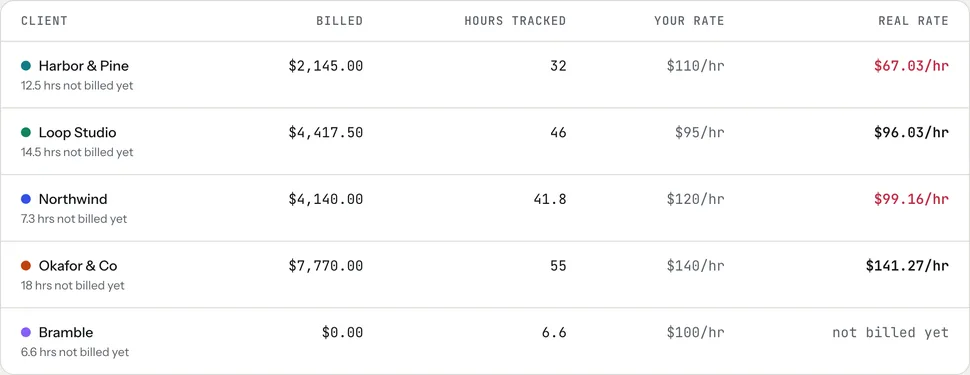
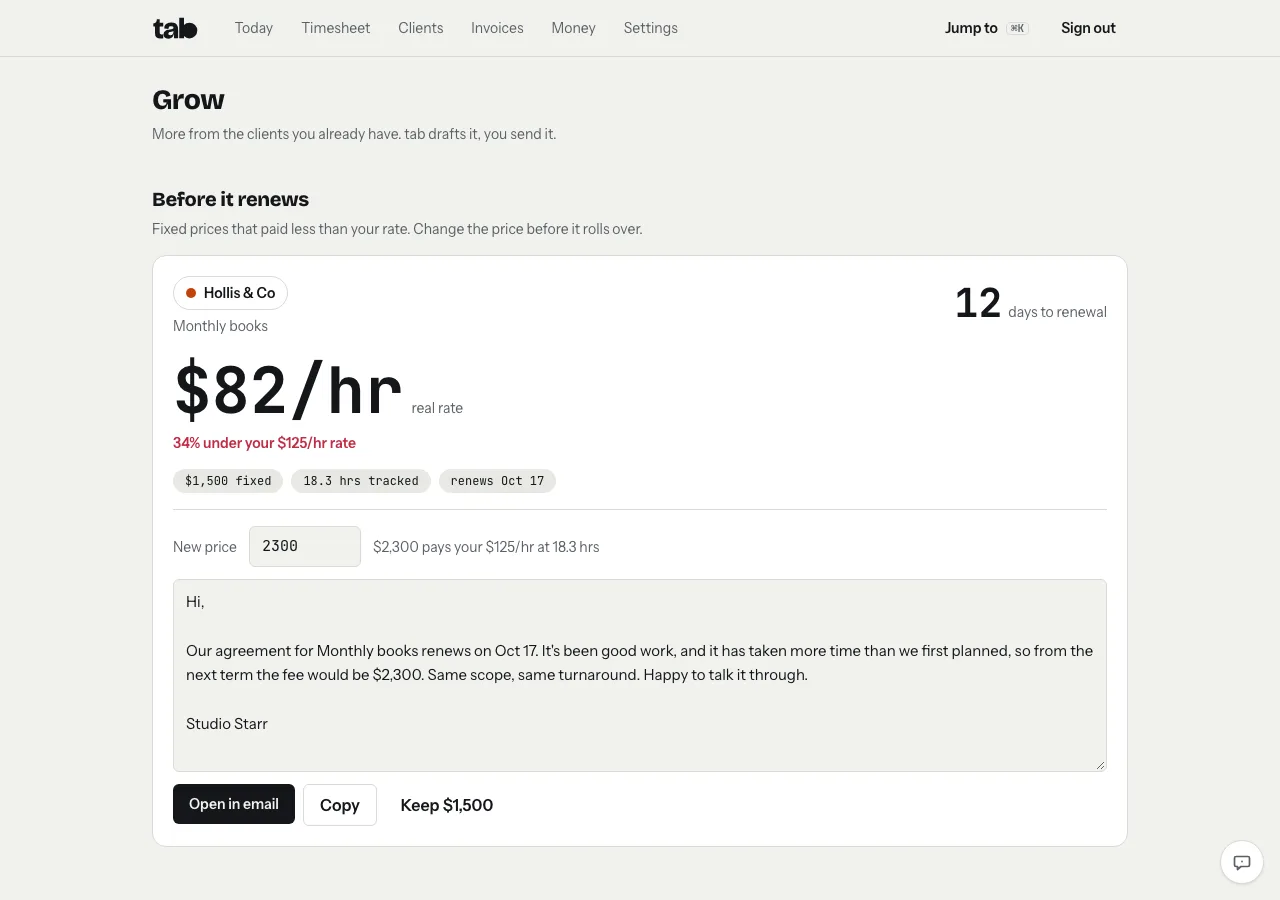
The table above is why the rate on paper isn't enough. If a client's real rate (what they paid divided by every hour you spent) is well under your rate, part of your insurance isn't being paid for. That client is the first one to talk to about pricing. If you work on fixed-price agreements, tab's Grow screen flags the ones paying under your rate before they renew, with a suggested new price and a drafted note you can edit:
The tax side, briefly
Self-employed people may be able to deduct health insurance premiums they pay. The IRS uses Form 7206 to work out the self-employed health insurance deduction, which goes on Schedule 1 of Form 1040 (IRS, about Form 7206). There are limits and conditions, so read the instructions or ask a tax professional before you count on it.
Checked October 26, 2026. General information, not tax advice.
A five-minute plan for this week
- Put November 1 and December 15 in your calendar.
- Pull this year's monthly income so your estimate is based on real numbers.
- Get a quote and add the yearly cost to your business costs.
- Check your rate still covers it, and raise it for next year if it doesn't. Negotiating your rate has wording.
Keep reading
 Start here57 free notes, sorted by what you need this week: first client, pricing, late payments, taxes.
 Side hustle to full-timeFour numbers to check before you quit: real rate, monthly costs, runway, and client risk.
 First client this week?The one-hour setup before you start: agreement, rate, payment terms, the clock, the invoice, tax.
Questions
When is open enrollment for 2027 health insurance?
On HealthCare.gov, open enrollment for 2027 coverage runs from November 1, 2026 to January 15, 2027. Enroll by December 15, 2026 for coverage that starts January 1. If your state runs its own Marketplace, you apply on its site, so check its dates there.
How do self-employed people get health insurance?
In the US, self-employed people with no employees can buy a plan on the individual Health Insurance Marketplace, and may qualify for savings based on estimated income and household size, or for Medicaid or CHIP depending on income.
How do I estimate my income for the Marketplace when it changes every month?
Estimate net self-employment income for the coverage year from what clients actually paid you, minus business costs, adjusted for what you expect next year. Update your application during the year if your income turns out very different.
How much should I add to my rate for health insurance?
Take the yearly premium plus expected out-of-pocket costs and divide by the hours you bill in a year. For example, $6,000 a year over 1,000 billable hours is $6 an hour.
Know what you earn, month by month.
tab tracks your hours, shows what each client really pays per hour, and what came in each month, so your rate and your estimates are built on real numbers. Free to start, no account to try it.
Start free Try it, no sign-upFree to startNo cardNo screenshots, ever