Notes · money & taxes
Look behind you: the freelance quarterly review
Four times a year, an hour before your estimated tax payment: five questions about your clients, your rate and your money, and one thing to change.
Updated 2026-10-27
Most freelancers only look back at their business once a year, at tax time, when it is too late to change anything. A quarterly review fixes that. Four times a year you sit down for about an hour, look honestly at the last few months, and pick one thing to change.
The picture with this note is a dark bathroom mirror and the line "don't look behind you". For your business, do the opposite: look behind you, on purpose, on a schedule. Here is when to do it, the five questions to answer, and where to find each number.
When: pair it with your estimated tax dates
If you are a US freelancer, you probably already have four dates a year that force you to look at your money: quarterly estimated tax payments. The IRS says individuals generally need to pay estimated tax if they expect to owe $1,000 or more when they file (IRS, Estimated taxes). The payment periods and due dates are:
- January 1 to March 31: due April 15
- April 1 to May 31: due June 15
- June 1 to August 31: due September 15
- September 1 to December 31: due January 15 of the next year
The periods are not equal in length, so don't assume each payment covers exactly three months. If a due date falls on a weekend or legal holiday, the payment is on time if you make it on the next business day (IRS, Estimated tax FAQ). For the 2026 tax year, the last payment is due January 15, 2027 (IRS Form 1040-ES, 2026).
Do your review a week or two before each due date. You need the numbers for the tax payment anyway, and having a deadline means it actually happens. The freelance tax calculator lists the dates and estimates what to set aside. This is general information, not tax advice; a tax professional can tell you what applies to you.
Checked October 26, 2026.
Question 1: what actually came in?
Start with two numbers for the period: what you billed (invoices sent) and what you collected (money that actually arrived). The gap between them is money you earned but don't have yet. Then add a third: how much is overdue right now.
In tab, the Money page shows all three: collected and billed per month, what's waiting to be paid, and what's overdue, with a link to the invoices past due. Write the numbers down somewhere you will see them next quarter. The point of a review is the comparison.
Question 2: what did each client really pay per hour?
This is the number that changes decisions. Take what you billed a client in the period and divide it by every hour you spent on them, including the calls, the revisions you didn't charge for and the admin. That is your real rate for that client.
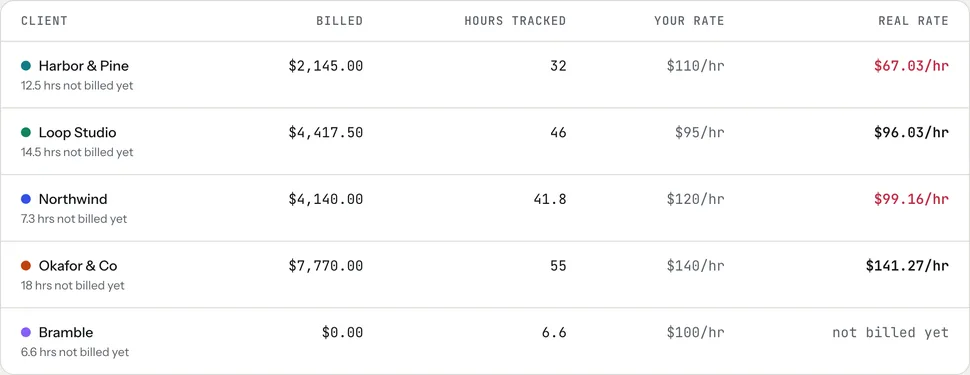
tab's Money page does this for you, with a "Last 3 months" view that fits a quarterly review. A real rate in red is more than 10% below the rate you set. Before you act on a red number, check the small line under the client's name: sometimes the hours just haven't been invoiced yet. If they have, you are looking at scope creep, too many unbilled calls, or a price that was too low. Our note on billable vs non-billable time covers how to sort those hours.
Fixed-price work needs the same check. A flat fee feels fine until you divide it by the hours it took.
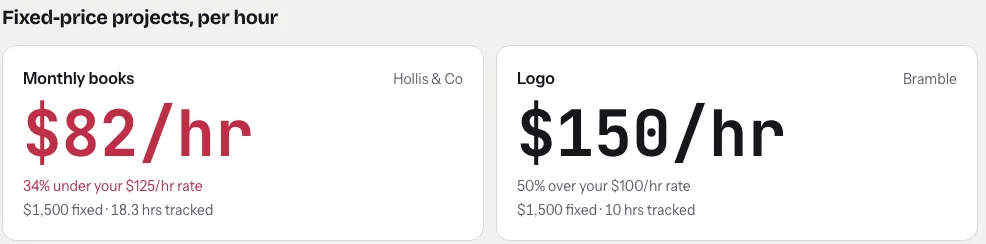
The real rate page explains the math, and four clients, one clock shows how a timer per client keeps every hour on the right tab.
Question 3: who pays late?
Go through the period's invoices and note which were paid after the due date, and by how many days. One late payment is noise. The same client late three times is a pattern, and patterns are fixable:
- Shorten their payment terms, or ask for a deposit before new work starts.
- Invoice them more often, in smaller amounts.
- Turn on tab's overdue reminders for that client only, so the polite chasing happens without you. They go out at 3, 10 and 21 days past due, from you, at most three times.
If an invoice from this quarter is already 60 days or more overdue, deal with it now rather than carrying it into the next review. The invoice that never came back walks through the final notice and what comes after.
Question 4: how much should be set aside?
Look at what you collected and what you have set aside for tax. tab's Money page shows a "Set aside for tax" amount for the month and the year so far, based on a percentage you choose (25% unless you change it, and you change it right on that page). If the set-aside is short of what the tax calculator suggests, the review is the moment to top it up, before the payment date rather than after.
Question 5: what is the one thing to change?
A review that ends with ten resolutions changes nothing. Pick one change for the next quarter, write it down, and check it at the next review. Some examples, based on what the numbers showed:
- A client with a low real rate: raise their rate or the next fixed price, or agree what's in scope.
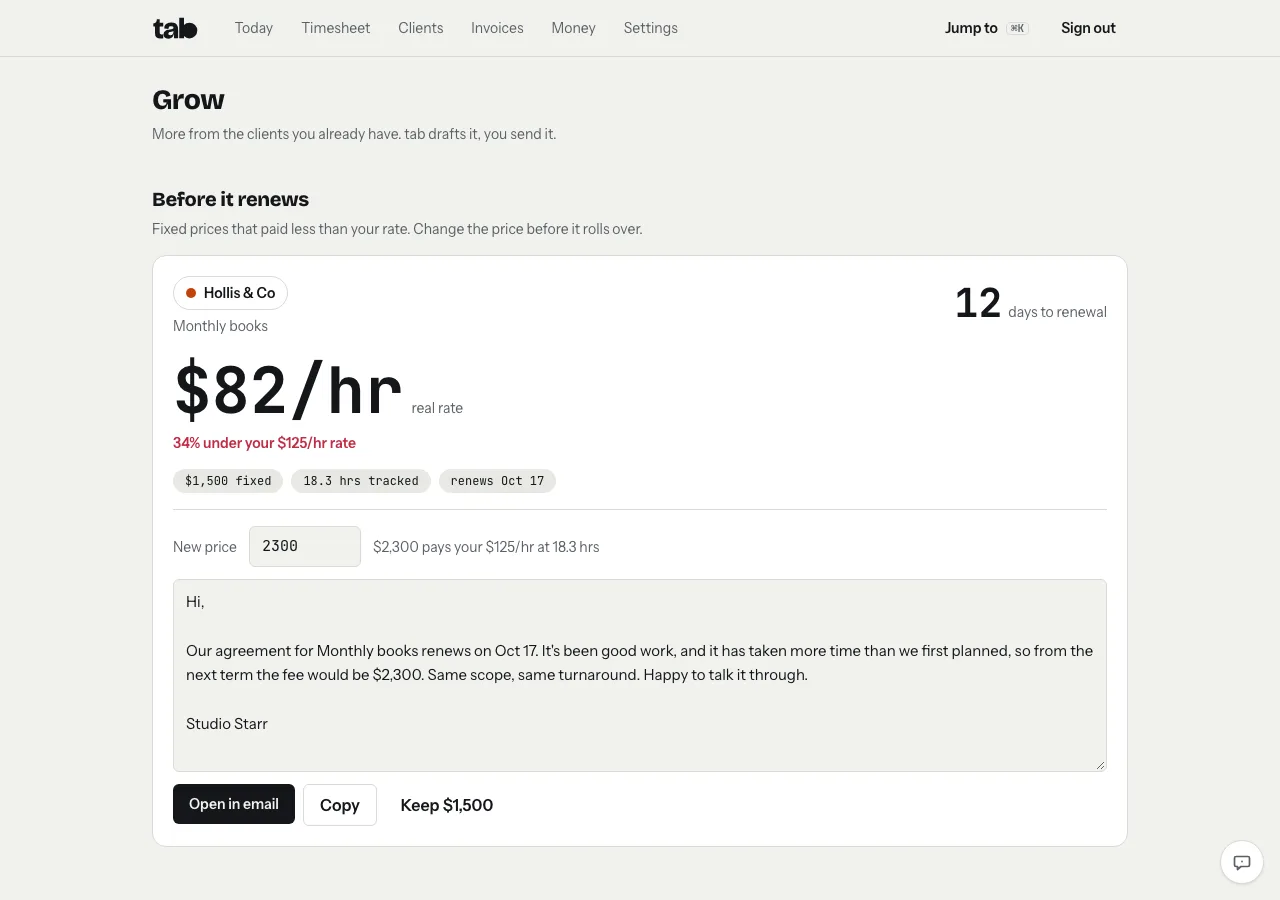
- A fixed-price renewal coming up: reprice it before it rolls over. tab's Grow screen flags fixed-price projects that renew in the next 30 days and paid less than your rate, with a suggested price and a drafted note you send yourself.
- A late payer: deposits, shorter terms or reminders, as above.
- Too many evenings: a rush fee for short-notice work. See when and how to charge a rush fee.
- A rate that hasn't moved in a year: check your field in the rate guides and rerun the hourly rate calculator.
A one-page review you can copy
- Billed this period, collected this period, overdue right now.
- Real rate for each client, lowest first. Anything more than 10% under your rate?
- Invoices paid late: which clients, how many days.
- Tax set aside vs. what the estimate says. Payment date and amount.
- The one change for next quarter, and how you will know it worked.
All of these numbers depend on one habit: tracking your time per client as you work, billable or not. If you aren't doing that yet, start today; the next review will thank you. The meter on the homepage runs without an account.
Keep reading
 Planning for a slow seasonYour monthly floor, a buffer from the good months, and the past clients to write to first.
 A separate business accountWhy the IRS says to keep business money apart, and how to set it up in an afternoon.
 An emergency fund, freelance styleYour monthly floor, a target in months, and a share of every payment until it's full.
Questions
What should a freelancer review every quarter?
What you billed and collected, what's overdue, the real hourly rate for each client (billed divided by every hour you spent), which clients paid late, how much you've set aside for tax, and one change to make next quarter.
When are quarterly estimated taxes due?
For income from January 1 to March 31, April 15; April 1 to May 31, June 15; June 1 to August 31, September 15; and September 1 to December 31, January 15 of the next year. A due date on a weekend or legal holiday moves to the next business day.
How do I calculate my real hourly rate per client?
Divide what you billed the client in a period by every hour you tracked for them, including hours you didn't bill. If it is well below your set rate, look for unbilled hours, scope creep or a fixed price that was too low.
How much should I set aside for taxes as a freelancer?
It depends on your income, location and deductions. tab defaults to 25% and lets you change it; the freelance tax calculator gives an estimate, and a tax professional can give you a figure for your situation.
Have the numbers ready before the review.
tab tracks your time per client, shows what each one really pays per hour, what's overdue and what to set aside for tax. Free to start, no account to try it.
Start free Try it, no sign-upFree to startNo cardNo screenshots, ever