Notes · pricing
Night shift: when and how to charge a rush fee
What counts as rush or after-hours work, four ways to price it, the words to use before you start, and how to put it on the invoice.
Updated 2026-10-27
A client emails at 6pm: can you have it ready by tomorrow morning? You can. You will be up late, you will move another client's work, and the evening you had planned is gone. The question is whether you charge the same as any other hour.
You don't have to. A rush fee is a normal, fair price for giving up your evening, your weekend, or your place in another client's queue. This note covers when a rush fee makes sense, the common ways to set one, how to say it before you start, and how to put it on the invoice so nobody is surprised.
What counts as rush or after-hours work
There is no official definition, so you write your own and use it the same way every time. Most freelancers use one or more of these:
- Short turnaround. The client wants it faster than your normal turnaround. If you usually quote five working days and they need it in one, that is rush.
- Outside your working hours. Evenings, weekends and public holidays, measured against the hours you actually publish or agree with clients.
- Jumping the queue. The work pushes another client's deadline back. Even if you do it at 2pm on a Tuesday, someone else pays for it with a delay, and you take the risk of that relationship.
What doesn't count: work that ran late because of your own planning, or an evening you chose to work because it suited you. A rush fee is for the client's urgency, not yours.
The night shift in the picture at the top is the part clients don't see. They see a file waiting for them at 9am. Your job is to make the cost of that file visible before you start, not after.
How much to charge: pick a method, not a magic number
You will find lots of "standard" rush percentages online. There is no official standard, and the right number depends on your field, your demand and how much you mind the late night. Pick a method you can explain in one sentence:
- A higher hourly rate for rush hours. For example, your normal rate is $80 an hour and rush hours are billed at $120. Easy to track, easy to explain, and the client pays more only for the hours that were actually rushed.
- A percentage on the whole job. For example, a flat project quoted at $1,200 gets a 25% rush fee, $300, if they need it in half the time. This suits fixed-price work, where hours don't appear on the invoice.
- A flat rush fee. For example, $150 added to any job needed within 24 hours. Simple for small jobs and quick edits.
- A minimum for after-hours calls. For example, any work started after 7pm is billed as at least one hour. This stops "can you just change one thing tonight" from costing you an evening for ten minutes of pay.
The numbers above are examples to show the math, not a recommendation. Start with a figure that makes you glad to say yes, not resentful. If you notice you are relieved when clients say no to the rush price, it is about right. If every client says yes without a pause, it may be low.
Not sure what your normal rate should be in the first place? Work it out with the hourly rate calculator or look up your field in the rate guides. A rush fee only works on top of a base rate you already trust.
How to say it (before you start)
The rush fee belongs in the yes, not the invoice. If the first time a client hears about it is when the bill arrives, it feels like a penalty. If they hear it when they ask, it is a choice they make. Three short replies you can adapt:
Notice the pattern: say yes, name the price, offer the normal-speed option. Giving the client a slower, cheaper choice matters. It shows the fee is about real cost, and many clients discover the deadline wasn't that firm after all.
Put it in writing, even if it's a one-line email. In some places this is more than good practice. New York City's Freelance Isn't Free Act, for example, requires contracts worth $800 or more (including several jobs adding up to $800 within 120 days) to be in writing, with the work, the pay and the payment date (NYC Department of Consumer and Worker Protection). A rush change to the price or deadline is worth confirming the same way. This is general information, not legal advice.
Checked October 26, 2026.
Track rush hours so the invoice backs you up
Rush work is the easiest work to under-bill. You are tired, you work in bursts, and the next morning nobody remembers whether it was three hours or five. Track it as you go, and keep it separate from normal hours so the invoice shows exactly what was rushed.
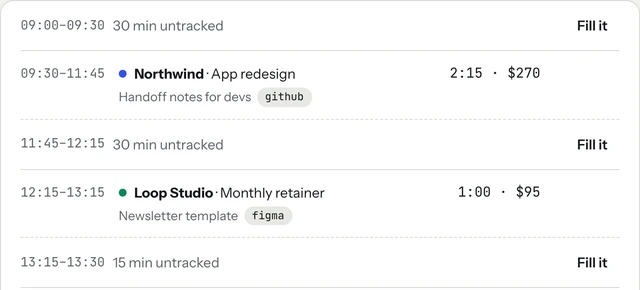
In tab, a project can have its own hourly rate, which is used instead of the client's normal rate. So you can add a project such as "Launch page, rush" at your rush rate, start the timer on it for the late-night work, and every hour lands at the right price without any math later. Each entry keeps its start and end time, so if a client asks why the bill is higher, you can show the evening it happened.
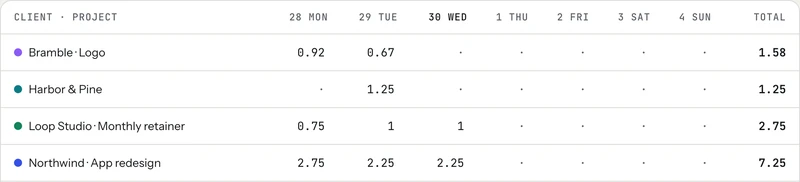
On the timesheet, each client and project gets its own row, so a rush project sits next to the normal work and is easy to see at the end of the week.
For a percentage or flat rush fee on a fixed-price job, add it as its own fixed line on the invoice, named plainly ("Rush delivery, 2-day turnaround"). A separate line is clearer than a bigger total, and it reminds the client next time that speed has a price.
Start the clock, no accountSign up free
When to waive it, and when to say no
A rush fee is a tool, not a rule. Some reasons to waive it:
- The rush is your fault, for example you missed something in the brief.
- It is genuinely tiny, and goodwill is worth more than the fee. Say so: "No rush charge this time." Clients remember a favour that is named.
And some reasons to decline, even at a higher price: the work needs care that a late night won't give it, the client rushes every job (that is a planning problem, not an emergency), or saying yes would make you miss a promise to someone else. "I can't do tonight, but I can have it to you Wednesday at noon" is a complete answer.
If rush jobs keep coming from the same client, check what that client really pays per hour. The real rate view divides what you billed by every hour you tracked, so late nights you forgot to charge for show up as a lower number. When you send the invoice, the free invoice generator lets you add the rush line in a minute.
Keep reading
 Negotiate your rateAnchor first, offer options, and trade scope instead of discounts. With wording you can copy.
 What goes into a freelance rateTax, costs, time off, unbilled hours and profit: the layers on top of your old hourly pay.
 Retainers and depositsGet paid before (or as) you work: deposits, monthly retainers, and the words to use.
Questions
How much should I charge for a rush job as a freelancer?
There's no official standard. Common methods are a higher hourly rate for rush hours, a percentage added to a fixed price, a flat rush fee, or a minimum charge for after-hours work. Pick one you can explain in a sentence and use it consistently.
Is it unprofessional to charge a rush fee?
No. A rush fee pays for giving up your evening or moving other clients' work. What feels unprofessional is a surprise charge, so name the fee when the client asks for the deadline and offer a normal-speed option.
Should I charge more for weekend or evening work?
Many freelancers do when the client asks for it, but not when they choose to work evenings for their own convenience. Define your working hours and put the after-hours terms in your proposal or contract.
How do I show a rush fee on an invoice?
Either bill rush hours at their own rate, or add the fee as a separate line such as 'Rush delivery, 2-day turnaround'. In tab you can give a rush project its own hourly rate, so its hours are priced correctly as you track them.
Bill every late night at the right rate.
tab tracks your hours per client and project, prices each one at the rate you set, and turns them into an invoice your client pays online. Free to start, no account to try it.
Start free Try it, no sign-upFree to startNo cardNo screenshots, ever