Notes · getting paid
Stop pulling: what to do when a client disputes an invoice
Find the knot, check your records, then correct, split or stand firm. With wording to copy, and what happens when a payment is disputed at the bank.
Updated 2026-10-27
In a tug of war, both sides pull hard and the knot in the middle barely moves. An invoice dispute can go the same way: the client says the bill is wrong, you say it's right, and every email pulls a little harder. Meanwhile nobody gets paid.
Most disputes end faster and better when you stop pulling and look at the knot: which line, which hours, which part of the agreement. This note walks through what to do when a client questions or refuses an invoice, the words to use, how to correct an invoice properly, and what happens if a client disputes a card or bank payment with their bank.
First: find out exactly what's disputed
"This invoice is too high" is a feeling. You need a fact. Before you defend anything, ask a short, calm question:
This does three things. It shows you take the question seriously. It narrows the problem from the whole invoice to specific lines. And it gives you a deadline you set yourself, so the matter doesn't drift.
Disputes usually fall into one of a few groups:
- Surprise at the hours. The client didn't expect the work to take this long.
- Scope. They believe something was included in the price; you believe it was extra.
- Quality or result. They aren't happy with part of the work.
- A real mistake. Wrong rate, a duplicate line, hours from another client.
- Cash trouble. The complaint is a way to delay paying. This one is harder to spot, but a vague objection that never becomes specific is a sign.
Check your own records first
Go back to what you agreed and what you did: the proposal or contract, any emails that changed the scope, and the time entries behind each line. Be honest with yourself. If you made a mistake, the fastest way out is to say so.
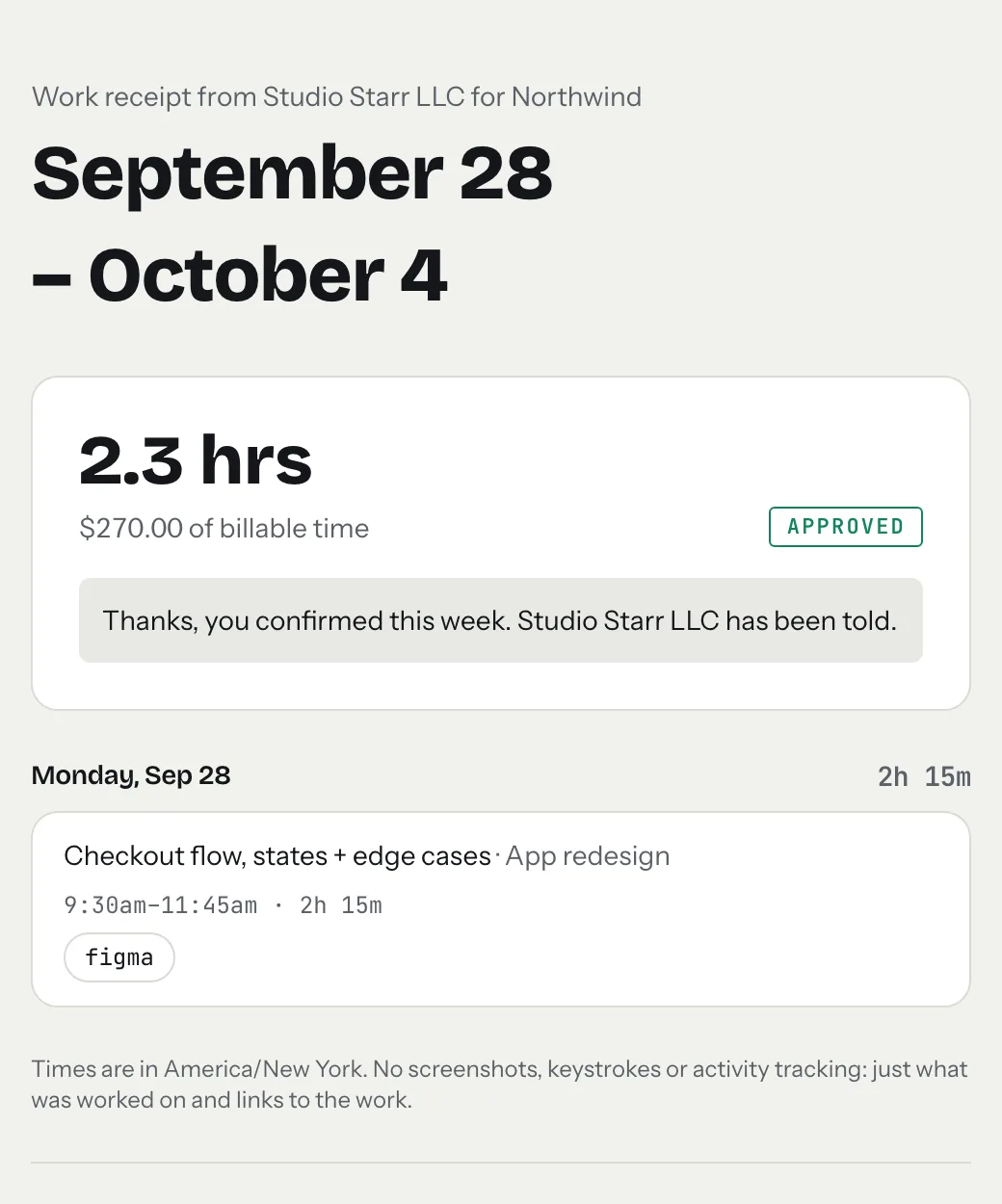
If you sent weekly updates, this step is much easier. In tab, each weekly work receipt shows the client's answer: weeks they approved are marked approved, and they also show as client-approved on the invoice. A week the client approved three weeks ago is a strong, friendly answer to "we never agreed to these hours".
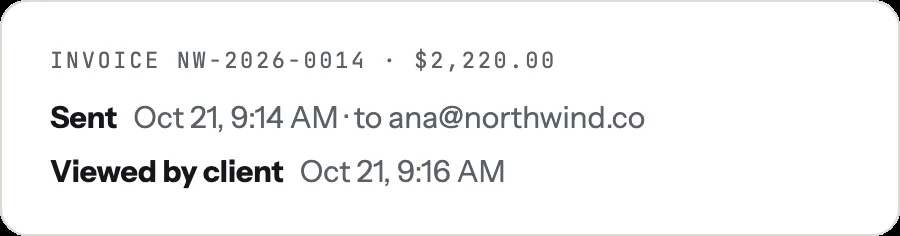
The invoice's own history helps too: tab shows when it was sent, to which address, and when the client first viewed it.
Then decide: correct, meet halfway, or stand firm
If it's your mistake, correct it
Apologize briefly, fix it, and send the corrected invoice. Don't edit a sent invoice in place or quietly reuse its number. The clean way is to cancel the old one with a credit note and issue a new one, so both of your records match.
tab works this way. A sent invoice can't be edited. Under More on the invoice, Fix this invoice voids it with a credit note and opens a new draft with the same hours, fixed fees, expenses, discounts, notes and tax, ready for you to correct. Void invoice does just the first part and puts the hours back on the client's tab. Both are available while no payment has been recorded on the invoice.
If only part is in question, split it
Often the client agrees with most of the invoice. Ask them to pay the part that isn't in question now, while you sort out the rest:
If they pay part, record it. In tab, Record a payment takes any amount up to what's owed, and the invoice shows as part paid with the balance still due.
If it's a gray area, offer a fair fix
For scope or quality disputes, a small concession can cost less than weeks of back and forth: a revised line, a discount on its own line, or fixing the part they're unhappy with at no extra charge. Make it a one-time offer in writing, and say what it settles.
If the invoice is right, say so plainly
Keep it factual, kind and short. Point to the agreement and the record, not to how hard you worked: "The scope we agreed on [date] covered X. The extra round on [date] was requested here [quote or link], and it's on its own line." Then restate the amount and the due date.
Pause the reminders while you talk
Automatic reminders that keep arriving during an honest disagreement can feel hostile. In tab, overdue reminders are switched on per client, so you can turn them off for that client while you settle it, and back on afterwards.
For a written record of the outcome, put the agreement in an email: what changes, the new amount and the new due date. If the client still won't pay after you've agreed, the invoice that never came back covers the final notice, small claims and when to let it go.
When the dispute goes to the bank
A different kind of dispute happens when a client asks their bank or card company to reverse a payment they already made. This is a chargeback, and it follows the payment network's rules, not yours.
- Card payments. Stripe says you usually have 7 to 21 days to respond, depending on the card network, and if you don't respond in time you lose automatically. You get one chance to submit evidence (Stripe: Respond to disputes). In the US, Stripe charges a $15.00 fee for each dispute you receive, and another $15.00 if you counter it, which you get back if you win (Stripe pricing).
- US bank (ACH) payments. Stripe says customers can generally dispute an ACH Direct Debit within 60 calendar days for a personal account, or two business days for a business account, and those disputes can't be contested through the ACH network. You contact the customer directly to resolve it (Stripe: ACH Direct Debit).
Checked October 26, 2026. General information, not legal advice.
When a client pays a tab invoice online, the money goes to your own Stripe account, and so does any dispute. tab marks the invoice "Needs your attention" with what happened and tells you to respond in your Stripe dashboard. Automatic reminders skip it while it needs attention. If the dispute is lost, the money comes off the invoice, it shows as unpaid again, and tab refunds its own fee on that amount. Your evidence is the same as above: the agreement, the approved receipts, and the invoice history.
Start the clock, no accountSign up free
Fewer disputes next time
- Agree the scope in writing before you start. Freelance contract basics covers what to include.
- Show the work every week, so the invoice holds no news. See weekly client updates.
- Write clear line items. Invoice line items clients don't question has wording you can copy.
- Price fixed work honestly. If fixed fees keep running over, check what they really paid per hour and quote the next one with the hourly rate calculator.
Keep reading



Questions
What should I do when a client disputes an invoice?
Ask which lines or hours they question, check your agreement and time records, then correct any real mistake, offer a fair fix for a gray area, or explain plainly why the invoice is right. Ask them to pay the undisputed part in the meantime.
How do I correct an invoice I already sent?
Don't edit it in place. Cancel it with a credit note and send a new invoice with the correct amounts, so your records and the client's match. In tab, Fix this invoice does both in one step.
Can a client ask the bank to reverse a payment?
Yes. Card payments can be disputed through the card issuer, and Stripe says you usually have 7 to 21 days to respond. US bank (ACH) debits can generally be disputed for up to 60 days on a personal account, and those can't be contested through the ACH network.
Does tab keep sending reminders on a disputed invoice?
Not when a payment on it has been disputed with the bank: the invoice is marked as needing your attention and reminders skip it. For a disagreement by email, turn overdue reminders off for that client until it's settled.
Invoices that come with proof.
tab sends clients a weekly receipt they approve, so the invoice is just the total, and fixing a mistake is one step. Free to start, no account to try it.
Start free Try it, no sign-upFree to startNo cardNo screenshots, ever