Notes · clients
What to put in writing before you start the work
Scope, rate, payment date, revisions and ownership, settled before day one. Plus a short email agreement and where a written contract is the law.
Updated 2026-10-27
Most freelance problems start before the work does. The client thought two rounds of changes were included; you thought one. They expected the source files; you planned to send PDFs. They pay "net 60"; you assumed two weeks. None of these are anyone being dishonest. They are things nobody wrote down.
A contract doesn't have to be a long legal document. For a lot of small jobs, a clear email the client replies "agreed" to does the job. What matters is that the important parts are settled and sealed before you start. Here is what to put in writing, a short template you can adapt, and the places where a written contract is required by law.
This is general information, not legal advice. For a large or unusual project, a lawyer where you live can review your terms.
The six things to put in writing
1. Who it's between
Your name or business name, the client's name and company, and an email for each. It sounds obvious, but "the client" is often a person at a company, and you want the invoice to go to whoever actually pays.
2. Scope: what you will deliver
List the deliverables as concrete things: "a homepage and two inner page designs in Figma," not "website design." Then add one line about what is not included, such as copywriting, development or stock photos. That line is what lets you say "happy to do that, it's extra" later without an argument.
3. Rate or price, and how changes are billed
Either an hourly rate, or a fixed price with what it covers. For fixed prices, say what happens if the scope grows: "work outside this scope is billed at $110 an hour, and I'll tell you before I start it." If you bill hourly, say how often you will invoice and how the client will see the hours. Not sure what to charge? See what goes into a freelance rate and how to negotiate it.
4. Payment date and terms
Write a real date or a number of days: "invoices are due 14 days after they're sent." For bigger projects, ask for a deposit up front or split the price into parts paid at set points. Include how the client can pay (bank transfer, card) and what happens if a payment is late, for example that work pauses until it is paid.
5. Revisions
How many rounds of changes are included, what counts as a round (one set of combined feedback, not a stream of separate messages), and the rate for extra rounds. This one clause prevents more scope creep than any other.
6. Ownership and use of the work
Say who owns the finished work and when. A common arrangement: the client owns the final deliverables once they have paid in full, and you may show the work in your portfolio. This is worth writing down because the default may not be what either of you expects. Under U.S. copyright law, the person who creates a work is ordinarily its author. Work an independent contractor is commissioned to make only counts as a "work made for hire," owned by the client, for certain types of work and when both parties sign a written agreement saying so (U.S. Copyright Office, Circular 30).
Two more lines are worth adding if they apply: the timeline (start date, key dates, and what happens if the client's feedback is late) and how either side can end the project early, including payment for work already done.
A short agreement you can send by email
For a small job, an email like this covers the basics. Ask the client to reply "agreed" and keep the thread.
Where a written contract is the law
Some places now require written contracts for freelance work above a certain size. Summaries of the official pages, read on October 26, 2026:
- New York City, Freelance Isn't Free Act. Contracts worth $800 or more, including several agreements that add up to $800 within 120 days, must be in writing. The contract must state the work you will perform, the pay for the work and the date you get paid, and both sides must keep a copy. With no payment date in the contract, the client must pay within 30 days after you complete the work. Source: NYC Department of Consumer and Worker Protection.
- New York State, Freelance Isn't Free Act. On August 28, 2024, the law added Article 44-A to the state's General Business Law, with contract requirements and a formal enforcement process. The Department of Labor publishes a model contract that can be used to meet those requirements, and complaints go to the New York State Attorney General. Source: New York State Department of Labor.
- Illinois, Freelance Worker Protection Act. Applies to contracts taking effect after July 1, 2024, for work worth $500 or more in a 120-day period. The written contract must include the name and contact information of both sides, an itemized list of the products and services, the rate and method of pay, the date payment is due, and the dates the services will be provided. Payment is due by the contract date, or within 30 days of completing the services if no date is set. Source: Illinois Department of Labor.
Notice how closely these lists match the six things above: who, what, how much, and when. Even where no law requires it, those are the terms that settle most disputes.
Checked October 26, 2026. Laws change and other places are considering similar rules; check the official page for where you and your client are.
Keep the paper trail going after you sign
A contract sets the terms; your records show you kept them. Two habits help:
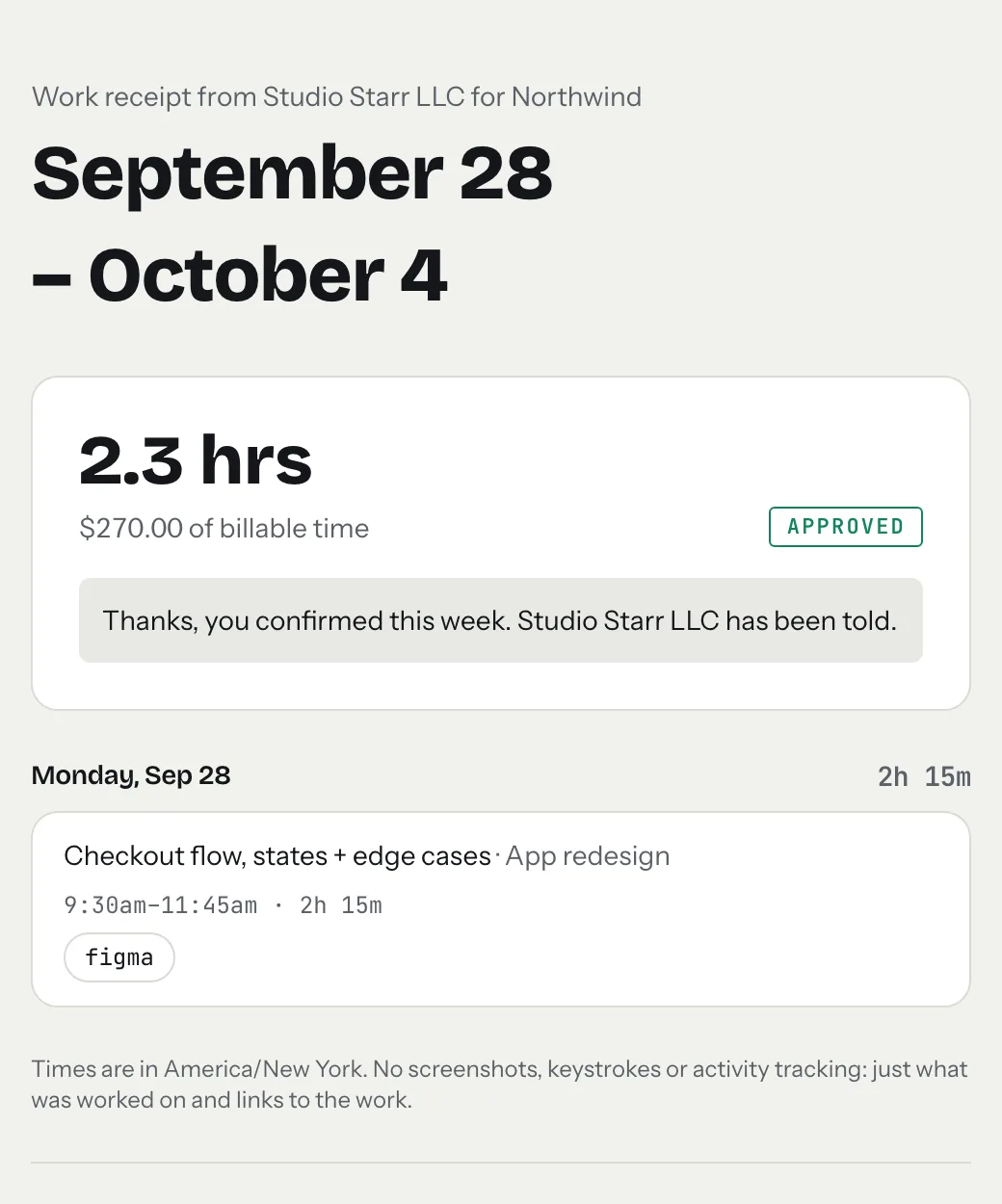
- Show the hours as you go. In tab, a weekly work receipt shows the client what you worked on, with links to the real work, and they confirm it with one tap. Approved hours rarely turn into an invoice dispute.
- Put the agreed payment date on every invoice. The due date on the invoice should match the terms in the contract, so there is never a question about when it is owed.
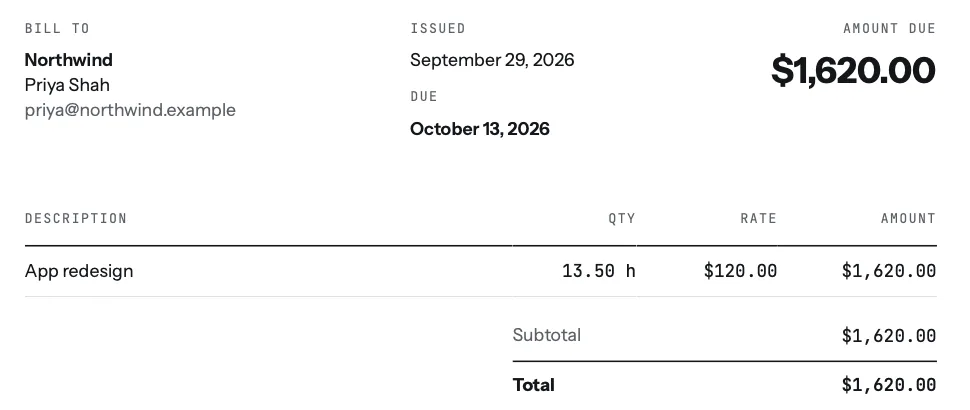
Need one now? The free invoice generator makes an invoice with a due date in a minute, and the meter on the homepage tracks hours against your rate with no account. If a client still pays late, the unpaid invoice follow-up schedule has the words to use.
Keep reading
 Weekly client updatesWhat to send every Friday so the invoice is just the total of things the client already saw.
 Saying no to clientsFour kinds of no (later, smaller, at my rate, not me) and the words for each.
 Client red flagsWarning signs in a new client, the money ones to take seriously, and a polite test.
Questions
What should a freelance contract include?
At minimum: who the agreement is between, the scope of work and what is not included, the rate or price, when and how you get paid, how many revisions are included, and who owns the finished work. A timeline and how either side can end the project are worth adding.
Is an email enough as a freelance contract?
For many small jobs, a clear email that sets out the terms, with the client replying that they agree, is a workable written record. For large projects, or where a law sets specific requirements, use a proper contract and consider a lawyer's review.
Do freelancers legally need a written contract?
In some places, yes. New York City requires one for freelance work worth $800 or more, including work adding up to $800 within 120 days. Illinois requires one for work worth $500 or more in 120 days, and New York State's Freelance Isn't Free Act sets contract requirements too.
Who owns the work a freelancer creates?
Under U.S. copyright law, the creator is ordinarily the author. Commissioned work only counts as a work made for hire for certain types of work and with a written agreement signed by both parties, so say in your contract who owns the work and when.
Keep the record as you work.
tab tracks hours per client, sends weekly work receipts your client approves, and turns them into an invoice with your payment date. Free to start, no account to try it.
Start free Try it, no sign-upFree to startNo cardNo screenshots, ever