Notes · pricing
Kill fees: getting paid when a client cancels
What a kill fee covers, three ways to set one up, and the contract wording to settle it while everyone is still on good terms.
Updated 2026-10-27
Sometimes a project ends before it's finished. The client's budget is cut, the company changes direction, the person who hired you leaves. Nobody did anything wrong, but you've blocked out the time, turned down other work and started on the job. Without an agreement, you may get paid for none of it.
A kill fee (also called a cancellation fee) is the line in your contract that says what you're paid if the client cuts the ribbon early. It belongs in any agreement for a project longer than a few days. Here is how kill fees work, how to set yours, and wording you can copy.
What a kill fee covers
A kill fee pays you for two things a cancellation takes away:
- The work already done. Research, drafts, concepts, calls. Often the hardest part of a project happens early.
- The time you held. If you turned down another client to make room, a cancellation leaves a gap you can't fill at short notice.
It isn't a penalty. It's the agreed price of ending early, settled while everyone is still on good terms.
Three ways to set it up
The figures below are examples to show the structure, not market rates. Choose what fits your work and use it consistently.
1. A percentage of the total fee
The simplest: "If the client cancels, they pay [X]% of the project fee." Easy to understand, but it ignores how far along the project is.
2. A percentage by stage
The fee rises as the project moves forward. For example, on a $3,000 project:
- Cancelled before work starts: the deposit is kept.
- Cancelled after the first concepts: 50% of the fee, $1,500.
- Cancelled after the final round of changes: 100% of the fee.
This is fairer to both sides and easy to tie to the milestones you've already written into the proposal.
3. Work done to date, plus a little
For hourly work or projects that are hard to split into stages: the client pays for the hours worked so far at your rate, plus a small fixed amount for the time you had held. This one depends on accurate time records, which is a good reason to track time even on fixed-price work.
A deposit is the first kill fee
The safest kill fee is money you already have. A non-refundable deposit, invoiced before you start, covers the earliest cancellations without anyone having to send another invoice. Retainers and deposits covers how to ask for one. Billing the rest in parts as the project moves means a cancellation never leaves you far ahead of payment.
Wording you can copy
Put the kill fee in your contract or proposal next to the price and payment terms:
If a client does cancel, keep the reply short and kind:
"I'd be glad to pick this up again" matters. A project paused for budget can come back, and the client will remember who made the ending easy. When it does, past clients are the easiest work to win.
Who owns the unfinished work
Settle this in the same clause. Under U.S. copyright law, the person who creates a work is generally its author. Work by an independent contractor only counts as a "work made for hire," owned by the client, if it falls into certain categories and both sides sign a written agreement saying so (U.S. Copyright Office, Circular 30). So tying the transfer of rights to payment, as in the wording above, is a clear arrangement: the client gets the drafts once the kill fee is paid.
A written agreement may be required anyway. In New York City, freelance contracts worth $800 or more must be in writing and must state the work, the pay and the date you get paid (NYC Department of Consumer and Worker Protection). The contract basics note lists what else to include.
Checked October 26, 2026. General information, not legal advice. For a large project, a lawyer where you live can review your terms.
Proof of the work done
A kill fee is easiest to collect when the client can see exactly what was done. That means a record of the hours and what each one was for, ideally one the client has already seen.
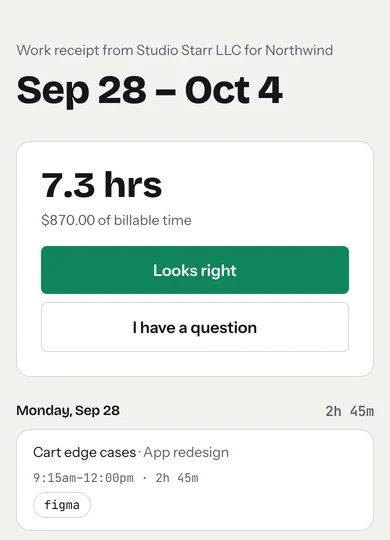
In tab you can track time on fixed-price projects as well as hourly ones, so even a flat-fee job has a record of the work. A weekly work receipt shows the client what you worked on, with links to the real files, and they approve it with one tap. If the project is cancelled, those approved weeks are the summary.
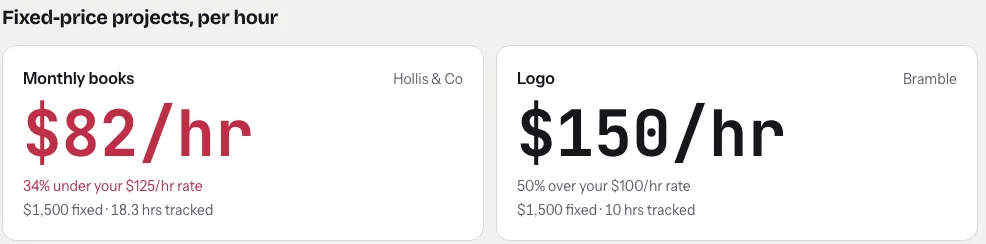
For fixed-price work, tab also shows what the project has paid per hour so far, which tells you whether a percentage-based kill fee would even cover the time you've put in.
To bill the fee, create an invoice for the client and add one item line, such as "Cancellation fee per agreement, [project]", or include the unbilled hours on it. With a fixed-price project split into parts ("Bill in parts"), the deposit can go out before any time is tracked. Not sure what your hours should cost? The hourly rate calculator gives you a number to put in the clause.
Keep reading
 Negotiate your rateAnchor first, offer options, and trade scope instead of discounts. With wording you can copy.
 What goes into a freelance rateTax, costs, time off, unbilled hours and profit: the layers on top of your old hourly pay.
 Retainers and depositsGet paid before (or as) you work: deposits, monthly retainers, and the words to use.
Questions
What is a kill fee?
A kill fee, or cancellation fee, is the amount a client agrees to pay if they cancel a project before it's finished. It covers the work already done and the time you held for the project. It has to be agreed in the contract before the work starts.
How much should a kill fee be?
There's no single standard. Common structures are a percentage of the total fee, a percentage that rises with each stage of the project, or payment for the hours worked so far plus a small fixed amount. A non-refundable deposit covers the earliest cancellations.
Who owns the work if a client cancels?
It depends on your contract. Under U.S. copyright law the creator is generally the author unless a written work-made-for-hire agreement applies, so your contract can state that rights to the work transfer once the kill fee is paid.
How do I invoice a kill fee?
Send a final invoice for the agreed amount with a short summary of the work done. In tab, create an invoice for the client and add an item line for the cancellation fee, or bill the unbilled hours you tracked.
Keep a record of every hour, even on flat fees.
tab tracks time per project, shows the client what was done with weekly receipts, and turns it into an invoice they pay online. Free to start, no account to try it.
Start free Try it, no sign-upFree to startNo cardNo screenshots, ever