Notes · getting paid
Late fees: should you charge one, and how to word it
When a late fee helps, the common ways to set it up, and wording for your contract, your invoice and the email when you charge it.
Updated 2026-10-27
An unpaid invoice is like a candle left burning: every day it sits there, a little more of your month melts away. A late fee is one way to give the due date some weight. It is also one of the most argued-about topics among freelancers, because it can protect your cash flow or sour a good client relationship, depending on how you use it.
Here is how to decide whether to charge one, the common ways to set it up, and wording you can put in your contract and on your invoice. This is general information, not legal advice.
Do you need a late fee at all?
A late fee works best as a reason to pay on time, not as a source of income. The goal is never to collect it. Three simpler things do most of the work of getting invoices paid:
- A real due date on every invoice, matching what you agreed. See net 15, net 30 or due on receipt for how to choose one.
- An easy way to pay, such as a link to pay by bank transfer or card.
- A polite follow-up schedule after the due date. Following up on an unpaid invoice has one, with the wording.
A late fee makes sense when a client has paid late more than once, when you're working with a company you don't know yet, or when late payments are putting real pressure on your own bills. It makes less sense with a long-standing client who has always paid, just slowly. There, a conversation about timing will usually do more.
The rule that matters most: agree it before the work
A late fee that appears for the first time on an overdue invoice is a surprise, and surprises get disputed. If you want the option, put it in your contract or proposal before you start, and repeat it on every invoice. Then charging it is just following terms the client already said yes to.
The contract basics note lists what else to put in writing, including the payment date.
Common ways to set it up
Freelancers usually pick one of three shapes. The amounts below are examples to show the structure, not recommendations.
- A flat fee. For example, $25 if the invoice is more than 14 days late. Simple to explain and easy to calculate.
- A percentage per month. For example, a set percentage of the unpaid balance for each month it stays unpaid. It scales with the size of the invoice, which suits larger projects.
- A grace period, then a fee. Any of the above, but only after a few days past the due date. A short grace period avoids charging someone whose payment was simply in transit.
Whatever you choose, keep it modest and keep it the same for every client. A fee that looks like a penalty invites an argument; one that looks like ordinary business terms usually doesn't.
Check your state and your contract
Rules about late fees and interest are not the same everywhere. What you can charge, and how it has to be written down, can depend on the state where you or your client are, the kind of agreement you have, and the exact wording of your contract. Before you add a late fee, check your own state's rules, or ask a lawyer or your local small business development center to look at your terms.
A few places also give freelancers protections of their own when payment is late, separate from any fee in your contract:
- New York City. Under the Freelance Isn't Free Act, if a contract has no payment date the client must pay within 30 days after you complete the work, and a freelancer who isn't paid on time can collect double the unpaid amount, plus attorneys' fees and costs (NYC Department of Consumer and Worker Protection).
- Illinois. Under the Freelance Worker Protection Act, for contracts taking effect after July 1, 2024 and work worth $500 or more in a 120-day period, payment is due by the contract date, or within 30 days of completing the work if no date is set (Illinois Department of Labor).
Checked October 26, 2026. General information, not legal advice. Laws change; check the official page for where you and your client are.
Wording you can copy
In your contract or proposal, next to the payment terms:
On the invoice itself, one plain line is enough:
And if you do have to charge it, keep the message calm and factual:
When to waive it
Being able to charge a fee doesn't mean you always should. Waiving it once, and saying so, can buy a lot of goodwill: "This one was late, so I'd normally add the late fee, but I've left it off this time." Good reasons to waive it: a first late payment from a good client, a mistake on your side (wrong email, missing details), or a client who told you ahead of time that payment would be late. Write down when you waived it, so you're consistent next time.
How tab handles late invoices
tab doesn't add late fees on its own. You decide if and when one applies. What it does do:
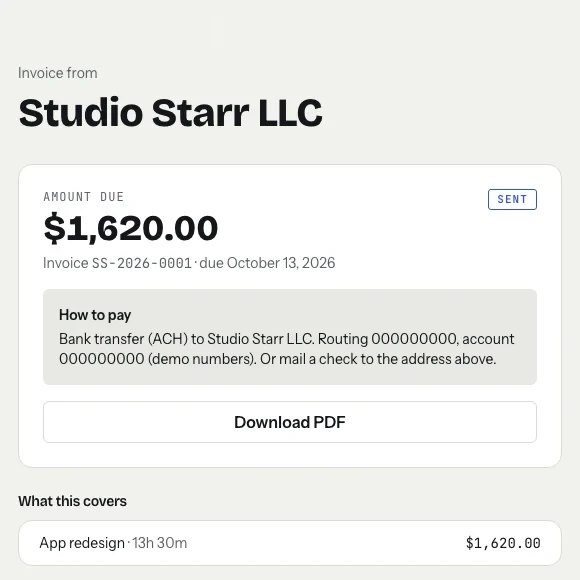
- Due dates on every invoice, from the payment terms you set for each client, changeable on any invoice.
- A note on the invoice, where you can repeat your late fee terms so the client sees them every time.
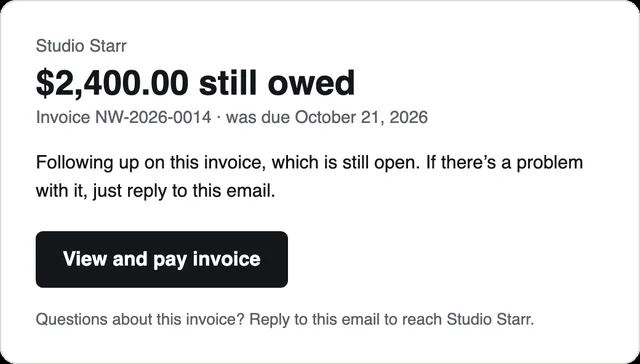
- Polite reminders, if you switch them on for a client: tab emails the client from you 3, 10 and 21 days after the due date, with the pay link, three at most.
- A separate invoice for the fee, if you charge one: create an invoice for that client and add one item line, such as "Late fee, invoice [number], as agreed."
If an invoice is already well past due, what to do when an invoice is 60 days late covers the next steps. And to see what a slow-paying client really costs you per hour, check their real rate.



Questions
Should freelancers charge late fees?
It can help, as long as the fee is agreed in your contract before the work starts and repeated on every invoice. Treat it as a reason to pay on time, not as income. Clear due dates, easy payment and polite reminders do most of the work.
How do I word a late fee on an invoice?
One plain line near the due date: 'Due [date]. As agreed, a late fee of $[amount] applies to invoices paid more than 7 days after the due date.' Use the same terms as your contract.
Is there a legal limit on late fees?
Rules on late fees and interest vary by state and by the type of agreement. Check your state's rules and your contract wording, or ask a lawyer, before adding one. This is general information, not legal advice.
Can I add a late fee to an invoice I've already sent?
It's cleaner to send the fee as its own small invoice that refers to the late one, and only if your contract allows it. In tab, create an invoice for the client and add one item line for the fee.
Make the due date hard to miss.
tab puts a due date on every invoice, lets the client pay online, and sends polite reminders when you switch them on. Free to start, no account to try it.
Start free Try it, no sign-upFree to startNo cardNo screenshots, ever