Notes · pricing
Should you charge for meetings?
Which calls are free, which are paid, how to price them, and the words to put in your agreement.
Updated 2026-10-27
A client asks for "a quick call". Then a weekly check-in. Then a review session with three more people from their team. Every one of those chairs around the table is taken by someone who is paid for the hour, except, often, the freelancer. Meetings are where a lot of freelance time quietly goes unbilled, mostly because nobody decided up front whether they count.
The short answer: once someone is a client, time you spend in meetings about their work is work, and it should be paid for, either by the hour or inside the price. The first conversation before they hire you is usually the exception. Here is how to sort meetings into free and paid, how to price them, and the wording to use.
Sort your meetings into three kinds
1. Before they're a client: usually free
A first call to understand what someone needs and whether you're a fit is part of finding work. Most freelancers don't charge for it. Keep it free, and keep it bounded: 20 to 30 minutes, with a clear end. Its job is to decide whether to send a proposal, not to solve the problem for free.
If a "first call" keeps turning into detailed advice, that advice is the work. Offer it as a paid session instead (more on that below).
2. Part of the project: paid, one way or another
Kickoffs, reviews, working sessions, feedback calls, check-ins. These exist because of the project, and they take your time just like the work itself. How you charge depends on how you bill:
- Hourly clients: bill meeting time at your normal rate, like any other hour. Say so in your agreement, so the first invoice with "Review call, 45m" on it isn't a surprise.
- Fixed-price projects: include a set number of meetings in the price, and say what happens beyond that. For example: "Includes a kickoff call and two review calls of up to an hour. Extra calls are billed at $[rate] per hour."
- Retainers: either count meetings against the monthly hours, or include a regular call (say, one 30-minute check-in a month) and count everything else.
3. Paid advice: a session with a price
A strategy session, an audit walkthrough, a "pick your brain" call. Here the meeting is the product. Give it a name, a length and a fixed price, and ask for payment when it's booked, not after.
Count the whole meeting, not just the call
A one-hour review usually costs more than an hour. There's the prep (pulling the work together, reading their feedback), the call itself, and the follow-up (writing up decisions, updating the brief). Track all three. If you're billing a fixed price, those hours are what tell you whether the meetings you included were priced right.
It also helps to set a minimum for short calls in your agreement. A 10-minute call still breaks up the work around it, so many freelancers bill calls in blocks, for example a minimum of 15 or 30 minutes. Whatever you choose, write it down before the first call, not on the invoice.
What to say
Clients rarely object to paying for meetings when they hear it at the start. Put it in the proposal or contract in plain words:
If a client is surprised by a meeting on an invoice, that is a sign it wasn't agreed clearly enough, not that you shouldn't have charged. Fix the wording for next time, and see freelance contract basics for the other things worth settling in writing.
Make meetings show up on the bill without arguments
The easiest way to bill a meeting is to log it the moment it ends, with a short note of what it was for. In tab you can type it in plain words in quick add, such as "45m northwind / review call", and it lands on Northwind's tab like any other entry. A forgotten call can be found later as a gap in your working hours and filled in.
Then the client sees it before any invoice goes out. tab's weekly work receipt lists each entry with its note, time and links to the work, and the client confirms the week with one tap:
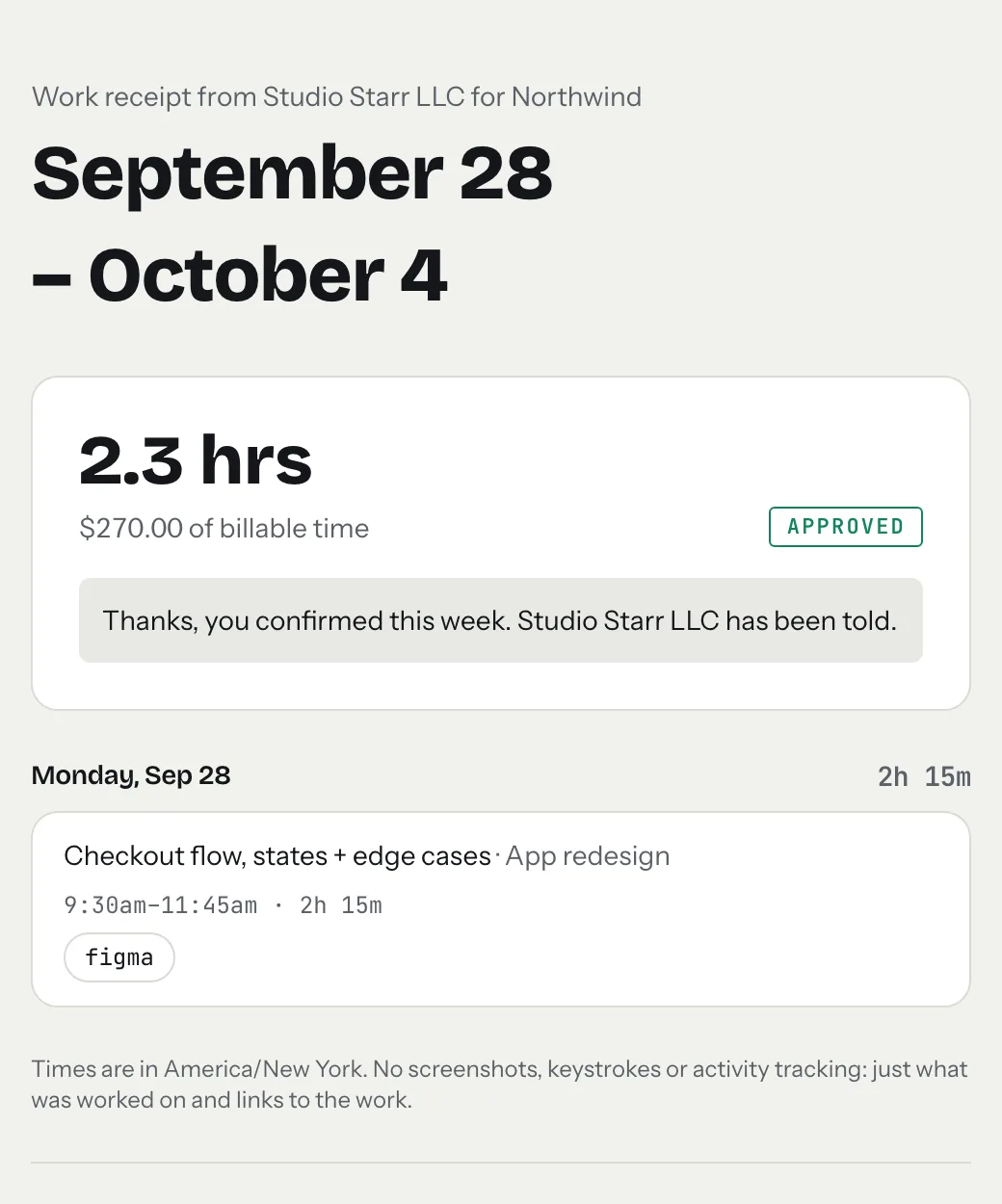
Seeing "Review call with your team, 1h" on a receipt they already approved makes the invoice a formality. More on this in weekly client updates.
Check what meetings are costing you
If you don't bill meetings, or they're inside a fixed price, they still use your hours. Track them anyway, marked not billable if you need to, and look at what each client really pays per hour once every tracked hour is counted:
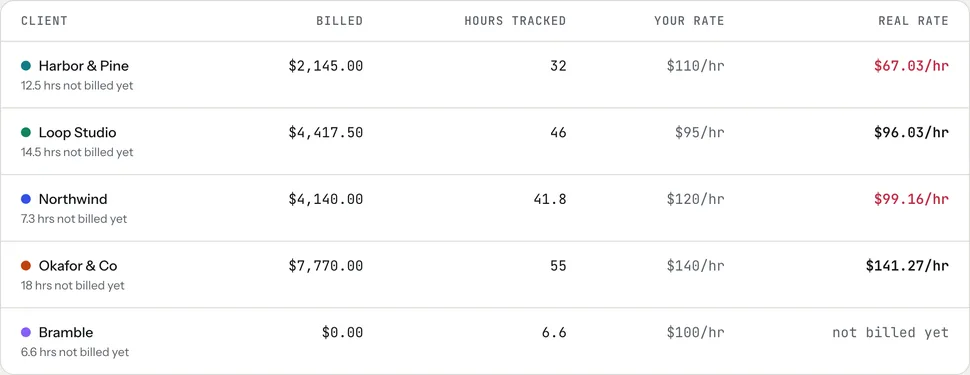
A client whose real rate sits well below your rate is often a client with a lot of unbilled calls. That's the moment to propose a change: bill meetings from next month, include fewer of them, or move to a fixed weekly check-in. The real rate page explains the number, and the hourly rate calculator helps you set a rate that covers the hours you can't bill. Billable vs non-billable time goes deeper on what to count.
Quick rules
- First call before hiring: free, 20 to 30 minutes, with a clear end.
- Project meetings: billed hourly, or a stated number included in the fixed price.
- Advice sessions: a named session with a fixed price, paid when booked.
- Count prep and follow-up, and set a minimum for short calls.
- Log every call when it ends, with a note the client can read.
Start with today's next call: track it on the meter on the homepage, no account needed.
Keep reading
 Negotiate your rateAnchor first, offer options, and trade scope instead of discounts. With wording you can copy.
 What goes into a freelance rateTax, costs, time off, unbilled hours and profit: the layers on top of your old hourly pay.
 Retainers and depositsGet paid before (or as) you work: deposits, monthly retainers, and the words to use.
Questions
Should freelancers charge for meetings?
Once someone is a client, yes: meetings about their project are work. Bill them at your hourly rate, or include a set number in a fixed price. A short first call before they hire you is usually free.
Should I charge for a discovery call?
A short first call to see if you're a fit is usually free. If it turns into detailed advice, offer a paid session with a set length and price instead.
How do I bill a short client call?
Log it right after with a note, and bill it like other time. Many freelancers set a minimum in their agreement, such as 15 or 30 minutes per call, because short calls still break up the work around them.
How do I tell a client I'm going to start charging for meetings?
Give notice before it applies, in writing: from a set date, project calls are billed at your hourly rate in stated increments. Offer an alternative, like a fixed weekly check-in included in the price.
Bill the calls, not just the work.
Log a call in plain words, show it on the client's weekly receipt, and see what every client really pays per hour. Free to start, no account to try it.
Start free Try it, no sign-upFree to startNo cardNo screenshots, ever