Notes · pricing
Every revision leaves crumbs: how to price them
Define a round, decide how many the price includes, and agree what extra rounds cost before anyone asks for one.
Updated 2026-10-27
Every revision leaves crumbs. A changed headline, a different shade, a section moved up the page: each one is small, and each one takes real time. Revisions are a normal part of creative and technical work, and clients are right to expect some. The problem is when "some" has no number, because then it quietly becomes "as many as it takes", and the last ten rounds come out of your rate.
You don't need to be strict to fix this. You need to decide how many revisions the price includes, say what counts as one, and agree in advance what happens after that. Here is how to do each, with wording for your proposal and for the moment a client asks for one more round.
Step 1: decide what a round is
"Two revisions" means nothing until you define a revision. Clients often think it means two changes; you probably mean two rounds of feedback. Write it the way you mean it:
- A round is one set of feedback, sent together. The client gathers every change from everyone involved into one message or document, and you make them all in one go.
- A round is on the work you already agreed. Adjusting the chosen design is a revision. Asking for a different direction, a new page or a new feature is new scope.
- Feedback has a time limit. For example, feedback within five working days of delivery. Otherwise a project can sit open for months.
The second point is the one that saves the most arguments. A revision makes the agreed thing better; a change of direction is a new piece of work, and it gets a new quote. The scope creep note covers how to handle that conversation.
Step 2: decide how many are included
There is no standard number. Pick one that fits the work and the price, and include it in every proposal so it becomes routine. A few things to weigh:
- How much the client can see in advance. Work where clients react to what they see, such as design, usually needs more rounds than work with a clear spec.
- How many people give feedback. More reviewers usually means more rounds, unless one person gathers their notes.
- The package level. If you offer good, better, best packages, revision rounds are one of the easiest things to vary between them: one, two or three.
Whatever you include, budget the hours for it when you price the job. If two rounds typically take you four hours, those four hours belong in the estimate. How to estimate project time walks through this.
Step 3: price the extra rounds
There are two common ways to charge for revisions beyond what's included. Either works; pick one and write it down.
By the hour
Extra revisions are billed at your hourly rate, tracked as you do them. This is the fairest when rounds vary a lot in size: a typo fix costs fifteen minutes, a rework costs a day. The client pays for what it actually took.
A flat fee per round
Each extra round has a set price. Work it out from your own history: if an average round takes you about 3 hours and your rate is $95, that's 3 × $95 = $285, which you might round to $300 a round. This is easier for clients to budget, but you carry the risk of a big round, so cap what a round covers.
With either method, tell the client before you start the extra round, not on the invoice. A client who agreed to the cost in advance has nothing to dispute later.
The wording
Each one is friendly, refers back to what was agreed, and puts a number on the extra work. Get the client's yes in writing, even a one-line email.
Put revision rounds in your written agreement anyway, along with the work and the payment date. In New York City, under the Freelance Isn't Free Act, contracts worth $800 or more, including work for the same client that adds up to $800 in any 120-day period, must be in writing and must state the work you will perform, the pay and the date you get paid. This is general information, not legal advice. Freelance contract basics has the rest.
Checked October 26, 2026. Source: NYC Department of Consumer and Worker Protection, Freelance Isn't Free Act.
Step 4: track revisions so you know what they cost
You can only price rounds well if you know how long they take. Track revision time separately from the first draft, for example as its own project for that client, such as "Website: revisions". After a few projects you'll know your real average per round, which is exactly the number your flat fee or estimate needs.
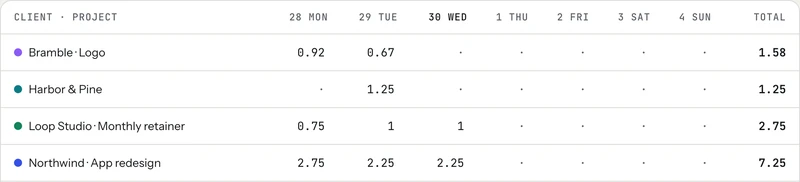
In tab, every hour goes on the right client and project as you work, and the weekly timesheet shows them side by side.
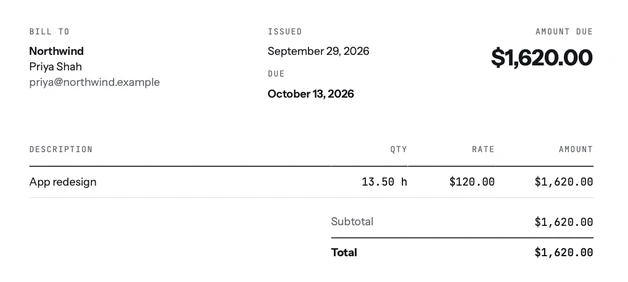
When you close the tab, the extra hours become invoice lines with the hours and your rate, on an invoice you check before sending. Without an app, the timesheet to invoice tool does the same from a list of hours.
On fixed-price work, revision time is where the real rate slips. tab shows each client's real rate: what you billed divided by every hour tracked, next to your set rate, in red when it falls more than 10% below it.

Try your own numbers on the real rate page, or start a clock on the homepage meter; it runs without an account.
Start the clock, no accountSign up free
A short checklist
- Define a round: one set of consolidated feedback, on the agreed work, within a set time.
- Include a number of rounds in every proposal, and budget the hours for them.
- Pick hourly or a flat fee for extra rounds, and write it down.
- Say the cost before starting an extra round and get a written yes.
- Track revision time separately, and use your real average next time you price.
Keep reading
 Negotiate your rateAnchor first, offer options, and trade scope instead of discounts. With wording you can copy.
 What goes into a freelance rateTax, costs, time off, unbilled hours and profit: the layers on top of your old hourly pay.
 Retainers and depositsGet paid before (or as) you work: deposits, monthly retainers, and the words to use.
Questions
How many revisions should a freelancer include?
There's no standard number; one to three rounds is common depending on the work and the price. What matters is writing the number down, defining a round as one set of consolidated feedback, and budgeting the hours for it.
How much should I charge for extra revisions?
Either your hourly rate for the time it takes, or a flat fee per round based on how long a round usually takes you. For example, 3 hours at $95 is $285, rounded to $300 a round.
What's the difference between a revision and new scope?
A revision adjusts the work you already agreed on. A different direction, a new page or a new feature is new scope, and it gets its own quote.
How do I tell a client a revision will cost extra?
Before you start it: say the included rounds are used, give an estimate in hours and money, and ask if they want you to go ahead. Then wait for a written yes.
Bill the extra rounds.
tab tracks every revision hour to the right client and turns them into invoice lines your client can pay online. Free to start, no account to try it.
Start free Try it, no sign-upFree to startNo cardNo screenshots, ever