Notes · clients
Push the first domino: how to get freelance referrals
Who to ask, when to ask, the exact words, and how to make it easy for a happy client to pass your name along.
Updated 2026-10-27
Line up a row of dominoes and you only have to push the first one. Referrals work a little like that. One client who was happy with your work tells a colleague, that colleague hires you, and a year later you notice that half your work came from three people who never saw an ad.
The catch is that the first push rarely happens by itself. Happy clients mean well, but they are busy, and "I'd be glad to recommend you" often stays a kind sentence. This note covers who to ask, when to ask, the exact words to use, and how to make it easy for someone to pass your name along.
Why referrals are worth the effort
A referred client arrives with something no cold lead has: a person they trust has already vouched for you. That usually changes the first conversation. They have heard what it is like to work with you, they often have a rough idea of your price, and they are less likely to treat you as one quote among ten.
Referrals also tend to look like the client who sent them. If your best client runs a small architecture firm, the people they know probably do too. That makes it worth being picky about whom you ask.
Who to ask
Not every client is a good source. Ask the ones you would happily work with again:
- Clients who paid on time. A client who paid every invoice without chasing is telling you something about how they run their business, and their friends often run theirs the same way.
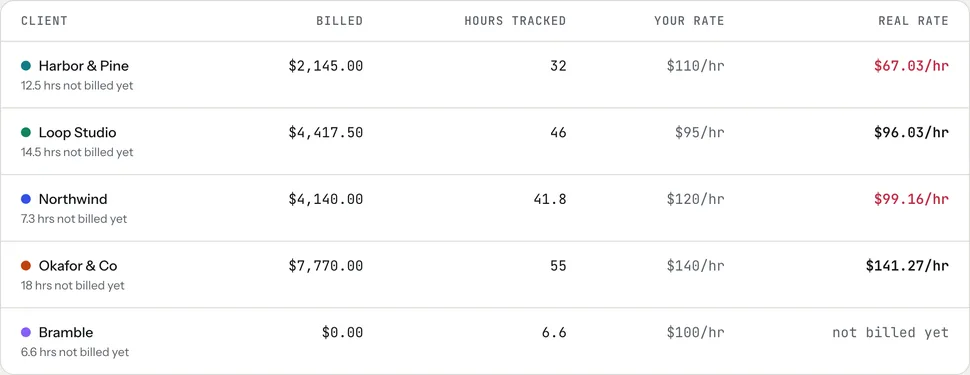
- Clients whose work paid well per hour. A fixed-fee client who took twice the hours you planned is not the kind you want more of. Check what each one really paid per hour before you ask.
- Clients who said something nice in writing. "This is exactly what we needed" in an email is a sign they would say it to someone else.
- People who are not clients. Other freelancers in nearby fields (a copywriter for a designer, a developer for a copywriter) see work they can't take, and former colleagues know what you are good at.
In tab, the Money page lists every client with what you billed, the hours you tracked and the real rate, which makes the "who do I want more of" question quick to answer.
When to ask
Timing matters more than wording. The best moments are right after the client feels the value of your work:
- When they approve or praise something. They just said "this looks great". That is the moment.
- At the end of a project, in the same message as the final files or the last invoice.
- When they come back for more work. A returning client is the strongest sign they are happy.
- A few months after a project ended, as part of a check-in. More on that below.
Avoid asking when something just went wrong, when an invoice is late, or in the middle of a busy deadline. Asking for a favor while they owe you money mixes two conversations.
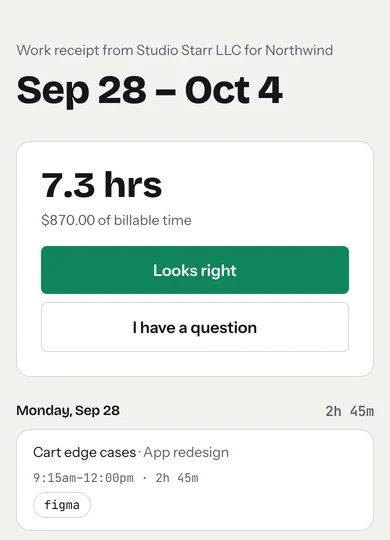
If you send clients a weekly work receipt in tab, the approval is a natural signal: the client tapped "Looks right" on the week, which is a good time for a short thank you and, now and then, the ask.
What to say
Be specific. "If you know anyone who needs help, let me know" is easy to agree with and easy to forget. Say what kind of client you want and make the next step small.
Notice the pattern: a thank you, who you help, one easy action. Give them a short line they can forward, for example "[Your name] does [what you do] for [type of client]. Here is their site: [link]." Most people will gladly forward something already written.
Make it easy to pass your name along
- One link. A simple page with what you do, two or three examples and how to reach you. A referral that ends in "I think they have a website somewhere" often goes nowhere.
- One sentence. If a client can't describe what you do in a sentence, they can't recommend you. Give them the sentence.
- Fast replies. When a referred lead writes, answer the same day if you can. The person who referred you will hear how it went.
Say thank you, every time
Thank the person who referred you whether or not the work came through. A short note is often enough. If it turns into a project, many freelancers send a small gift or offer a discount on the referrer's next project.
If you give a gift, keep the tax rule in mind. The IRS says you can deduct no more than $25 for business gifts you give to each person during your tax year, and incidental costs like packaging and mailing generally don't count toward that limit (IRS Publication 463, chapter 3). Paying someone a cash referral fee is a different matter, so check with a tax professional before you set up a paid referral program.
Checked October 26, 2026. General information, not tax advice.
Keep the chain going
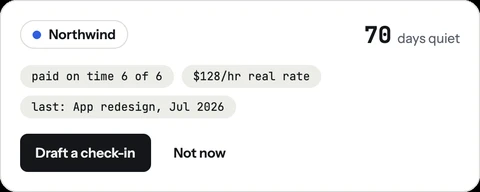
The clients who have gone quiet are often the easiest to ask, because they already know your work. tab's Grow screen has a "Who to go back to" list: clients who paid you before and have had no time or invoices for a while, best first, with how often they paid on time, their real rate and the last project. It drafts a check-in note you can open in your own email or copy. tab never emails the client for you.
For the full check-in routine, read reaching out to past clients, and see how tab finds them. If you are still building the first row of dominoes, getting your name out covers the other channels. And when a referral becomes a project, price it with the hourly rate calculator or your field's rate guide, not with a "friend of a friend" discount.
Keep reading
 Freelance contract basicsThe six things to settle in writing before you start, and where the law requires it.
 Weekly client updatesWhat to send every Friday so the invoice is just the total of things the client already saw.
 Saying no to clientsFour kinds of no (later, smaller, at my rate, not me) and the words for each.
Questions
When is the best time to ask a client for a referral?
Right after they feel the value of your work: when they approve or praise something, at the end of a project, when they come back for more, or in a friendly check-in a few months later. Avoid asking when an invoice is late or something just went wrong.
How do I ask for a referral without sounding pushy?
Thank them, say what kind of client you're looking for, and make the next step small, such as forwarding one email. Give them a one-line description and a link they can pass on.
Should I pay for referrals?
Many freelancers say thank you with a note, a small gift or a discount on the referrer's next project. Business gifts are deductible only up to $25 per person per year in the US; for cash referral fees, check with a tax professional first.
Which clients should I ask for referrals?
The ones you'd happily work with again: clients who paid on time, whose work paid well per hour, and who have said something positive in writing. Their contacts often look like them.
Know which clients to ask.
tab shows what every client really paid per hour, who paid on time, and who has gone quiet. Free to start, no account to try it.
Start free Try it, no sign-upFree to startNo cardNo screenshots, ever