Notes · time tracking
Time tracking for freelance writers: what a per-word rate really pays
Per word or per hour, the hours tell you which clients and pieces are worth it. What to track, and how to find your real rate per piece.
Updated 2026-10-27
Most freelance writers are paid by the word, by the piece or by the project, not by the hour. So why track time at all? Because a per-word rate only tells you what a piece paid. It doesn't tell you what it paid per hour of your life, and that is the number that decides whether a client, a type of work or a rate is worth keeping.
This guide covers how to compare per-word and hourly pricing, what to track (it is more than the drafting), and how to work out your real rate on every piece.
Per word vs per hour: what each one hides
Per word (or per piece) is easy for clients to budget and rewards you for writing quickly. It hides everything that isn't typing: the interview that ran long, the extra source you had to find, the third round of edits.
Per hour pays you for all of that, but clients can't see the final cost upfront, and you earn less when you get faster.
You don't have to pick one forever. Many writers quote per word or per project and track hours in the background. The hours never go on the invoice; they are there so you can check the rate after the piece is done.
Here is a worked example with made-up numbers. A 1,500-word article at $0.20 a word pays $300. If it took 3 hours of drafting, that looks like $100 an hour. But add 2 hours of research and interviews and 1 hour of revisions, and it took 6 hours: $50 an hour, half of what you thought.
What to track (it's more than the writing)
Set up each client as a client and each piece or series as a project, then time every kind of work on it:
- Pitching and briefing: calls, emails and outlines before you start.
- Research: reading, interviews, transcribing, checking facts.
- Drafting: the part everyone thinks of.
- Revisions: each round of edits, tracked separately if you can, because this is where pieces quietly get expensive.
- Admin: uploading to a CMS, finding images, invoicing.
A short note on each entry ("round 2 edits", "interview with source") is enough. Later, it tells you which part of the job ate the hours.
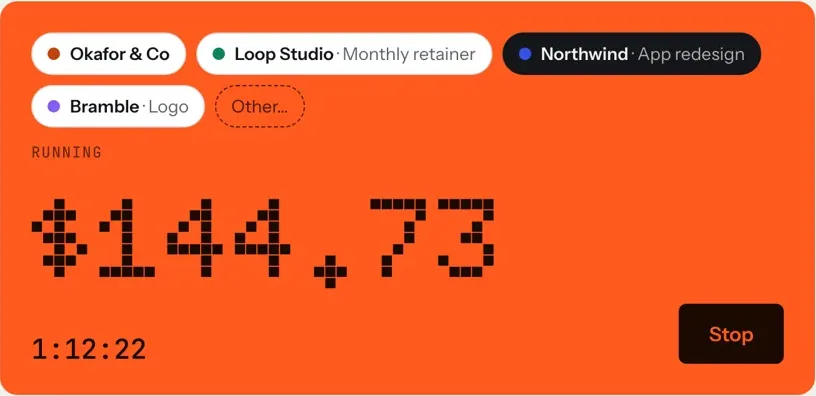
If you write for several clients in the same day, switching should take one tap, or you will stop doing it. In tab you tap a client to move the clock to them, and you can add time you forgot in plain words, like "2h research northwind yesterday".
Your real rate per piece
Your real rate is what a piece paid divided by every hour it took, including the hours you would never put on an invoice. Work it out for each finished piece and you start to see patterns: one client whose edits double the time, one format that always pays well, one rate that only works for topics you already know.
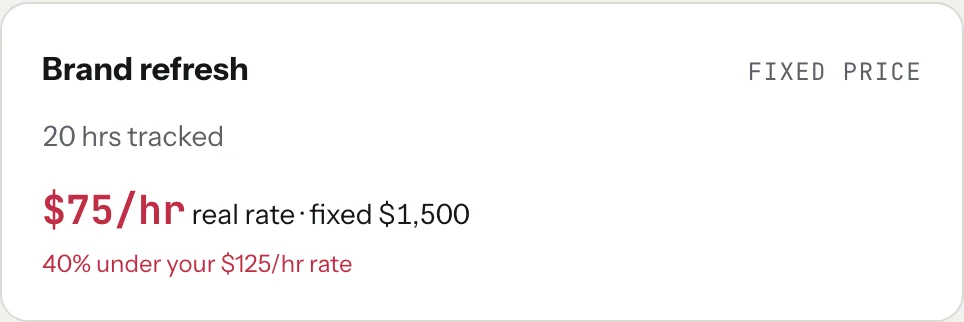
In tab, set a fixed fee on a project and it shows your real hourly rate while you work, and how far it sits above or below your usual rate. The real rate page explains the idea in more detail, and the real hourly rate note walks through the math.
Once you know your real numbers, set your next per-word or per-piece quote from them. Decide the hourly rate you need (the hourly rate calculator helps), estimate the hours a piece really takes, and work back to a per-word price. The rate guides for a freelance writer, copywriter and editor give you a floor to compare with.
Use your hours to quote the next piece
After a handful of pieces, your time log becomes your best pricing tool. Group similar work together (blog posts, case studies, newsletters, long reports) and look at the typical hours for each. If case studies take you about 8 hours from interview to final draft and you need $80 an hour, a case study should be quoted at $640 or more, whatever that works out to per word. Those numbers are an example; yours will come from your own log.
Give a project an estimate in tab and the Money screen compares it with the hours you have actually used, so you can see a piece running long while there is still time to talk to the client about scope.
When you do bill by the hour
Editing, ghostwriting, content strategy and retainers are often billed hourly. Then the time log is the invoice, and it helps if the client can see what the hours were for. tab sends a weekly work receipt with each entry's note and links to the work, such as the Google Doc, which the client can approve in one tap. Approved hours then become an invoice the client can pay online.
Keep the work you do for yourself off the client's clock. In tab, untick Billable on an entry, so it counts toward your hours without landing on an invoice.
November, 50,000 words and the client work
For many writers November means trying to write a 50,000-word draft in 30 days. National Novel Writing Month, the nonprofit that ran the best-known version of that challenge, closed in April 2025, according to ProWritingAid. The challenge itself lives on: ProWritingAid now runs a free event called Novel November from November 1 to 30, 2026, with the same 50,000-word goal, about 1,667 words a day. Plenty of writers also just set the goal on their own or with a local group.
Checked October 26, 2026.
If you freelance at the same time, the hours matter more than usual in November. Start the clock when you write for a client, stop it when you switch to your own pages. That way the client words get billed, your novel time stays yours, and at the end of the month you know exactly how the two shared your days.

Keep reading
 Finding unbilled hoursThe gaps, quick calls and forgotten timers, and a ten-minute Friday check to catch them.
 Track time by projectOne client, several jobs: split every hour onto the right project, and bill each one right.
 Freelance working hoursSet your hours, share them once, protect focus time, and see where the week really goes.
Questions
Should freelance writers charge per word or per hour?
Both work. Per word or per piece is easier for clients to budget; per hour pays for research and revisions. Many writers quote per word or per project and track their hours privately to check what each piece really paid per hour.
How do I work out my hourly rate on a per-word job?
Divide what the piece paid by every hour it took, including research, interviews, revisions and admin. A 1,500-word piece at $0.20 a word ($300) that took 6 hours in total paid $50 an hour.
Is NaNoWriMo still running?
No. National Novel Writing Month, the nonprofit, closed in April 2025. ProWritingAid runs a free November challenge called Novel November with the same 50,000-word goal, and many writers set the goal on their own.
Can I track time on personal writing without billing it?
Yes. In tab you can mark an entry as not billable, so it counts toward your hours but never lands on a client's invoice.
Know what every piece really paid.
tab tracks your hours per client and project, shows your real rate on fixed-fee work, and bills the hourly jobs for you. Free to start, no account to try it.
Start free Try it, no sign-upFree to startNo cardNo screenshots, ever