Notes · clients
Put out the welcome mat: a client onboarding checklist
The steps to run with every new client, a welcome email you can copy, and what to set up before the first hour of work.
Updated 2026-10-27
The client said yes. Now there is a gap between "let's do it" and the first real piece of work, and what happens in that gap shapes the whole project. If the start is fuzzy, you spend the first two weeks chasing logins, guessing who approves things, and finding out at invoice time that the invoice needed a purchase order number.
Onboarding is just putting out the welcome mat: a short, repeatable set of steps you run with every new client, so they know how working with you goes and you have everything you need to start and to get paid. Here is a checklist you can copy, a welcome email you can adapt, and what to set up on your side.
Before any work: the paperwork
Do these before the first hour of work, while the client is still excited to get going.
- A written agreement. What you will deliver, the price or hourly rate, how many revision rounds, and when you get paid. Freelance contract basics walks through the six things to put in writing.
- A deposit, if you take one. For fixed-price work, a share of the fee up front is normal. Retainers and deposits has the wording.
- Your tax form, if they ask. A US client that pays you may ask for Form W-9. The IRS describes it as the form you use to provide your correct taxpayer identification number to the person who is required to file an information return reporting what they paid you. Send it through a secure channel, not as a plain email attachment if you can avoid it.
In some places the written agreement is required by law. In New York City, under the Freelance Isn't Free Act, contracts worth $800 or more, including agreements with the same client that add up to $800 in any 120-day period, must be in writing and must state the work, the pay and the date you get paid. This is general information, not legal or tax advice.
Checked October 26, 2026. Sources: IRS, About Form W-9; NYC Department of Consumer and Worker Protection, Freelance Isn't Free Act.
Collect the billing details now, not on invoice day
The most common reason a first invoice is paid late is that it went to the wrong place or was missing something. Ask these questions in the first week, in one message:
- Who receives invoices? Often it isn't the person you work with. Get the billing contact's name and email (many companies use an accounts payable inbox).
- Do invoices need anything on them? A purchase order number, a project code, a specific company name or address.
- How do they prefer to pay? Bank transfer, card or check. Bank transfer usually costs you less in fees; the payment fee calculator shows the difference on any amount.
- When do they pay? Confirm the payment terms in your agreement (for example, due in 14 days) still work with their payment runs.
The kickoff: agree how you'll work together
A 30-minute call or a single shared doc covers it. You want answers to five questions:
- Who decides? One person who gives final feedback and approves work. If three people send notes, ask who has the final say.
- Where do we talk? Email, Slack, a project tool. Pick one main channel so nothing gets lost.
- When can they expect replies? Share your working hours and a response time, such as "replies within one working day". This note on working hours has wording for it.
- What do you need from them? Logins, brand files, content, a list of contacts. Put it in a checklist with a date.
- How will they see progress? A short weekly update keeps invoices from being a surprise. Weekly client updates shows what to include.
A welcome email you can send
Send this the day the agreement is signed. It confirms everything in one place the client can find again.
Keep a copy of this email as a template. The second time you send it, it takes two minutes, and every client gets the same clear start.
Set the client up on your side
Add the client to whatever you use to track time and invoice before you start, so the first hour is tracked to the right place. In tab, a new client takes the client name, your hourly rate and currency, then optionally a billing email, when payment is due (on receipt, or 7 to 60 days), how to round each time entry, and whether tab should send polite overdue reminders. If you work on fixed-price projects, add the project with its price; you can split it into parts so a deposit can be invoiced before any time is tracked.
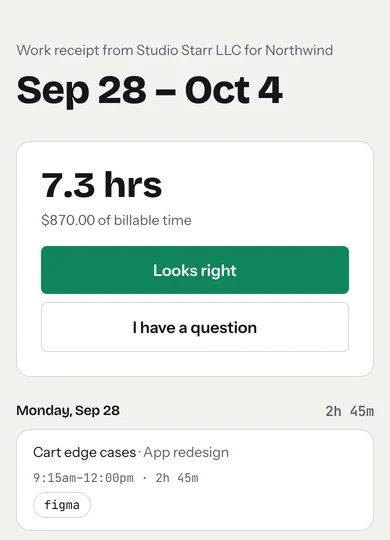
From the first week, tab can send the client a work receipt: the hours, what you worked on, links to the real work, and a button to confirm it.
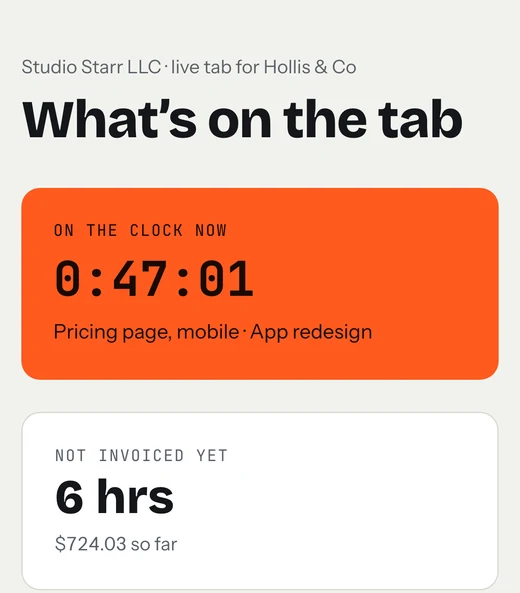
Each new client also gets a live tab by default: a private link where they can see, at any time, whether the clock is running and what has been tracked but not invoiced yet. You can turn it off for a client, or show hours only.
The first week: start the clock from minute one
The kickoff call, reading the brief, setting up files: that is work on the project, and it counts. Track it from the first minute, even if some of it ends up non-billable, so you know what onboarding really costs you per client. If it regularly takes three unpaid hours, build that into your price next time with the hourly rate calculator.
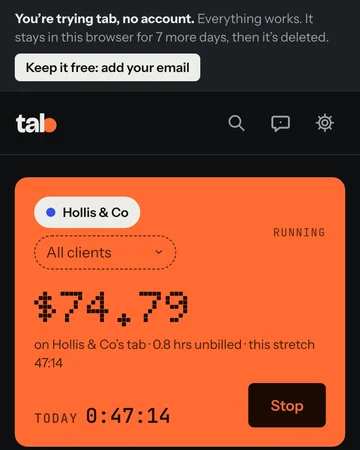
You can try it right now: the meter on the homepage runs without an account.
Start the clock, no accountSign up free
The checklist
- Agreement signed: deliverables, price, revision rounds, payment date.
- Deposit invoiced and paid, if you take one.
- W-9 or other tax form sent, if requested.
- Billing contact, invoice requirements, payment method and terms confirmed.
- Kickoff: decision maker, main channel, your hours, what you need and by when.
- Welcome email sent and saved as a template.
- Client and project set up in your time tracker before the first hour.
- First weekly update on the calendar.
Keep reading
 Freelance contract basicsThe six things to settle in writing before you start, and where the law requires it.
 Weekly client updatesWhat to send every Friday so the invoice is just the total of things the client already saw.
 Saying no to clientsFour kinds of no (later, smaller, at my rate, not me) and the words for each.
Questions
What should a freelance client onboarding process include?
A signed agreement, any deposit, the client's billing details (who receives invoices, PO numbers, how they pay), a kickoff to agree who approves work and where you talk, a welcome email that confirms it all, and setting the client up in your time tracker before the first hour.
What should I put in a client welcome email?
The start date, what you need from them and by when, your working hours and response time, how they'll see progress, and where invoices go with the payment terms. Keep it short enough to read in a minute.
Should I charge for onboarding time?
Track it either way. Kickoff calls and setup are real work. Whether you bill them by the hour or build them into a fixed price, knowing how long onboarding takes helps you price the next client.
Why would a new client ask for a W-9?
A US client uses Form W-9 to get your correct taxpayer identification number so it can report what it paid you to the IRS. It's a routine request; send it securely.
Start every client the same clear way.
Add the client with their rate and payment terms, track from minute one, and send a weekly receipt they confirm. Free to start, no account to try it.
Start free Try it, no sign-upFree to startNo cardNo screenshots, ever