Notes · getting paid
Your first invoice: what goes on it
The eight things every invoice needs, the choices to make once, and how to send it so the client pays on time.
Updated 2026-10-27
The work is done, the client is happy, and now you need to send your first invoice. It is a strangely nervous moment. You are asking for money in writing, you don't know what a "proper" invoice looks like, and you don't want the first bill you ever send to look amateur.
The good news: an invoice is a simple document, and clients mostly want the same eight things on it. Here is what goes on your first invoice, in order, with an example, plus the few choices you have to make once and then reuse for every invoice after it.
The eight things every invoice needs
- The word "Invoice" and a unique number. The number is how you and the client talk about this bill, and how both of you find it later. It never repeats.
- Your details. Your name or business name, an address and an email address. If you trade under a business name, use the same one on your contract.
- The client's details. The company name, the person you work with, and their email. If the client has an accounts payable team, ask who invoices should go to before you send.
- The issue date. The day you send it.
- The due date. A real date, not just "due on receipt". Fourteen or thirty days after the issue date are both common.
- What you are charging for. One line per piece of work: what it was, the quantity (hours or items), the rate and the amount.
- The total. A subtotal, any tax on its own line, and the amount due in large type.
- How to pay you. A pay link, bank transfer details, or where to send a check. The fewer steps, the faster you get paid.
Here is how those eight things look on one page:
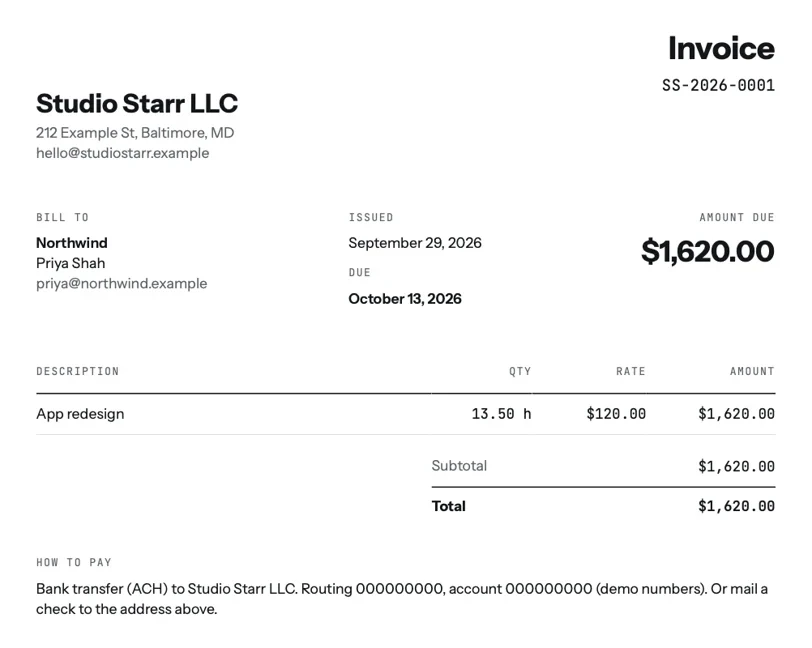
Notice what isn't there: no long terms and conditions, no explanation of the work. The contract or proposal already covers those. The invoice is just the bill for something the client already agreed to.
Decide these once, then reuse them
Your numbering system
Pick a format you can keep for years. A short prefix, the year and a running number works well: SS-2026-0001, SS-2026-0002, and so on. Don't start at 0001 on every new client, and don't skip numbers. A simple invoice numbering system goes through the options.
Your payment terms
Choose a standard due period, say 14 days, and put it in your contract so the due date on the invoice is no surprise. Write it on every invoice as a date.
How you will be paid
Bank transfer is cheapest. Cards are most convenient for the client but cost you more. If you take payments online through Stripe in the US, its standard fee is 0.8% capped at $5 for ACH bank debits, or 2.9% + 30¢ for domestic cards (Stripe pricing). On a $1,620 invoice, that is $5 by bank or about $47 by card. The payment fee calculator shows the difference on any amount.
Checked October 26, 2026.
Write line items the client can check
Describe the work in the client's language, not yours. "App redesign: checkout flow and mobile states" beats "Design work". If you bill by the hour, show the hours and the rate; if it's a fixed price, show the project name and the agreed amount. Keep each line short enough to read in one glance.
If you tracked your time, the line items mostly write themselves. Timesheet to invoice turns a list of hours into lines, and the free invoice generator makes the whole invoice as a PDF in your browser, no account needed.
A few legal and tax basics
This is general information, not tax or legal advice.
- Keep a copy of every invoice. The IRS lists invoices among the supporting documents for your business income, alongside deposit records and Forms 1099 (IRS: what kind of records should I keep). Save the PDF; don't rely on your sent email.
- Never put your Social Security number on an invoice. A client who needs your taxpayer number for their records will ask with a Form W-9. If you'd like a separate business number, the IRS issues an Employer Identification Number free, and warns against websites that charge for one (IRS: get an EIN).
- In the UK, an invoice has to include a unique number, your name and any business name, your address and contact details, the customer's name and address, a description of what you're charging for, the supply date, the invoice date, the amounts, VAT if applicable, and the total owed. If you and your customer are both VAT registered, you need a full VAT invoice (GOV.UK).
- Sales tax or VAT, if you're registered for it, goes on its own line below the subtotal. Rules depend on where you and the client are, so check with your state or national tax authority before adding it.
Checked October 26, 2026.
Send it, then make it easy to pay
Email the invoice to the person who approves it, with the invoice number, your name and the amount in the subject line, and a short, friendly message. How to email an invoice has wording you can copy. A short version:
In tab, the client gets a link to a page with the amount, the due date, how to pay and what the invoice covers, plus a PDF to download. When online payments are on, the page has a Pay button for bank transfer or card, paid into your own Stripe account.
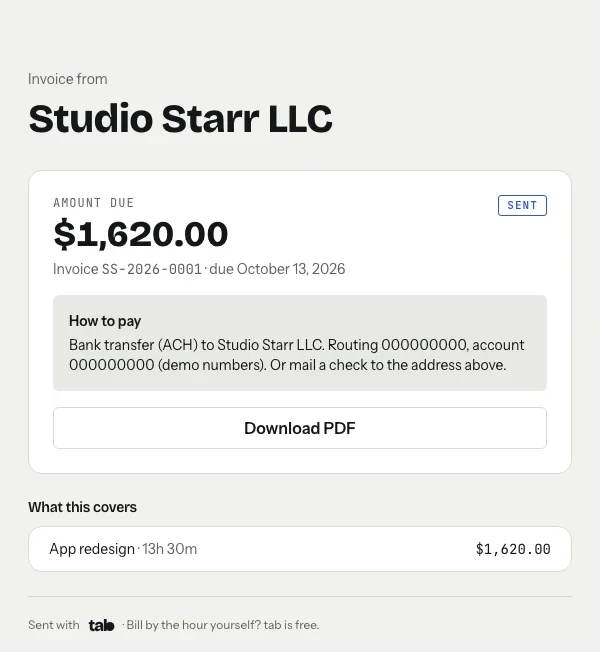
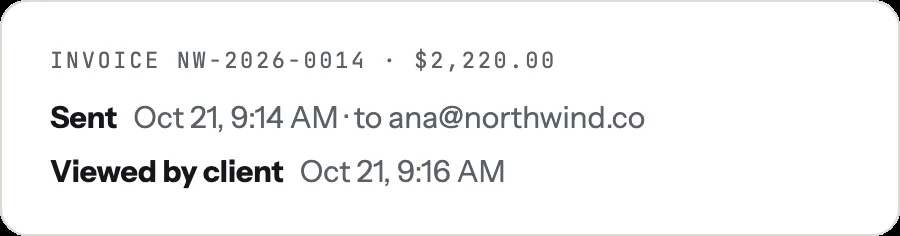
Before you send, set up your details once in tab's settings: the name on invoices, address, logo (free on every plan) and a number prefix. Each client has its own payment terms, so the due date fills in by itself. The invoice also records when it was sent and when the client opened it:
Your first-invoice checklist
- Invoice number in your long-term format.
- Your details and the client's, spelled the way they are on the contract.
- Issue date and a real due date.
- Clear line items, a subtotal, any tax, and the total.
- How to pay, in as few steps as possible.
- Saved as a PDF in your records, then emailed to the right person.
If the due date passes without payment, following up on an unpaid invoice has a calm schedule and the words to use.
Keep reading



Questions
What should be on a freelance invoice?
The word Invoice and a unique number, your details, the client's details, the issue date, a due date, a line for each piece of work with quantity, rate and amount, the total (with any tax on its own line), and how to pay you.
What number should my first invoice be?
Any number you can keep counting from. A short prefix, the year and a running number, such as SS-2026-0001, is easy to keep. Don't restart the count for each client and don't skip numbers.
Should I put my Social Security number on an invoice?
No. A client who needs your taxpayer number will ask for a Form W-9. If you want a separate business number, the IRS issues an EIN free.
When should the first invoice be due?
Pick a standard period, such as 14 or 30 days after the issue date, agree it in your contract, and write the actual due date on the invoice.
Make your first invoice in a minute.
Track the hours, close the tab, and send an invoice with your logo that the client can pay online. Free to start, no account to try it.
Start free Try it, no sign-upFree to startNo cardNo screenshots, ever